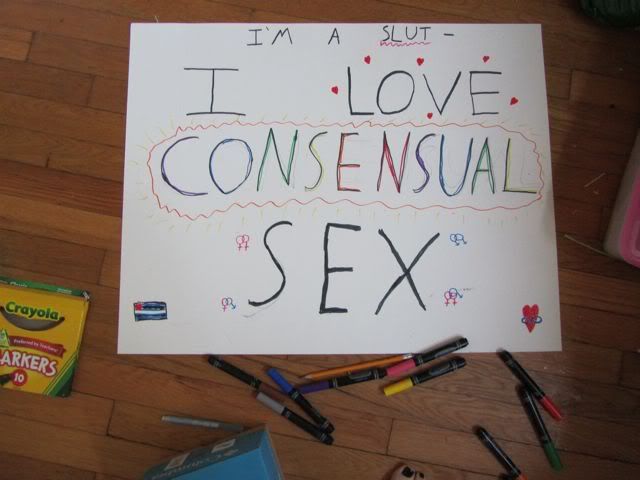
A consent culture is one in which the prevailing narrative of sex--in fact, of human interaction--is centered around mutual consent. It is a culture with an abhorrence of forcing anyone into anything, a respect for the absolute necessity of bodily autonomy, a culture that believes that a person is always the best judge of their own wants and needs.
I don't want to limit it to sex. A consent culture is one in which mutual consent is part of social life as well. Don't want to talk to someone? You don't have to. Don't want a hug? That's okay, no hug then. Don't want to try the fish? That's fine. (As someone with weird food aversions, I have a special hatred for "just taste a little!") Don't want to be tickled or noogied? Then it's not funny to chase you down and do it anyway.
The good news is, there are things you can do to bring this about. Things beyond just "don't rape people" (although that's an excellent start).
Ways You Can Work Toward The Creation Of a Consent Culture
1. Don't rape people. It does bear saying. And I don't just mean "don't put on a ski mask and jump on strangers in dark alleys" rape, either. Don't have sex with someone who is not unambiguously, enthusiastically, and continually consenting. Don't have sex with someone who says "I guess so" or "okay, fine" (unless they are grinning lasciviously as they say this). Don't convince someone to have sex. If they don't want you, really want you from the bottom of their heart and/or groin, respect that.
2. When someone doesn't want to have sex with you and so you don't, talk about it. Share that you're bummed but also that you take pride in your ability to take it gracefully.
When you didn't want to have sex with someone and so they stopped, talk about it. Share that despite the awkwardness you're glad they took it gracefully.
These are tough things to discuss (in part because they sound kind of Captain Obvious, like, no shit it was nice of you not to rape someone), but they're important narratives to put out there. Others' stories shape our ideas about sex, and hearing stories that fall outside the "have sex or you're a failure" mindset are important in changing those ideas.
3. When someone tells you about pressuring or tricking someone into sex (and you're in a situation where it's safe to do so), call them the hell out on it. "That's not cool. It doesn't sound like he/she wanted it." You don't have to use the R word, you don't have to tell them they should be arrested, you don't have to call them a rapist piece of shit--you just have to make it clear they're not getting any goddamn high fives. When you hear someone bragging about sex like it was a prank they pulled on their partner, bring the mood in the room the hell down.
You can do this with fictional stories, too. You don't even have to be no-fun then. "Wow, you guys, 'Baby It's Cold Outside' is totally a date rape song." Without requiring a rant or a buzzkill, it just quietly plants the idea that no, that is not a "totally legit way to get sex" song.
4. When you see something that looks abusive or nonconsensual going on, don't turn your back. At least be a witness--just the presence of another person can be someone's biggest guarantee of safety. Stepping in and checking if everything's okay is even better.
5. Ask before touching people. Say "do you want a hug?" and if they say no then don't hug them--and also don't give them any shit about not being friendly or affectionate. Don't make a big deal out of it, just make it part of your touching-people procedure. If they say "you don't need to ask!" nod and smile and keep on asking.
6. Negotiate sex! Explicitly negotiate sex play, and BDSM play if you do that. Be eminently clear about the fact that play is not a package deal for you, and your partner is free to change their mind about any part of it at any time--as are you. Err on the side of blunt, and say corny shit like "can I kiss you now?" and "I'd like to touch your chest."
Once in a blue moon (really not as often as some people would have you think), you may run into a partner who refuses to negotiate, or who says "I would have done it before you killed the mood by asking." Do not have sex or play with this person. Their loss. This is you putting the principle of "consent matters" above the principle of "have sex at all costs!", and you can brag about it when you're busy changing narratives.
7. Re-negotiate sex! While I don't think every step of "can I kiss you now?" is necessary in a long-term relationship (although Rowdy and I really do ask every time about intercourse), it's important to keep talking about what you want and don't want. You're not strangers anymore, no, but you're also not merged into the same person. Keep active consent alive in your relationships.
8. Learn to love consent. I worry that I've made getting consent sound like a chore. It's anything but. Asking for consent is a moment of delicious tension, of emotional connection.
A "yes" brings the joy of knowing someone is really hot for you, really wants you. It means that they're going to not just go along with but be into the stuff that comes next. That's not "prerequisite checked off," that's "awesome, this is going to be so much better now."
A "yes, conditionally" helps you be a better lover to them, someone who can give them just what they want and nothing they don't want.
9. Learn to appreciate "no." A "no, not at all" is bittersweet--or okay, sometimes it's fucking crushing--but it brings some finality and certainty with it. If you're not going to have sex anyway (and you're not, unless you were going to rape this person), at least you get to banish the "maybe I could have, why didn't I try" thoughts.
Remember that ultimately asking for consent is not asking someone to make a decision whether they want sex with you or not. That decision's going to get made, one way or another. Asking for consent is simply asking to know about that decision.
10. Talk about consent. Make consent part of the stories you tell about sex. Just a natural part of the process, something that ought to be taken for granted will be part of a sex story.
"So last night I asked Sandra if she wanted to hook up and she totally said yes."
"Ohmygod, Jane asked me to have sex with her, and it was awwwwesome."
"I heard that Rob and Josie--I'll totally kill you if you tell anyone--totally agreed to have sex at Jesse's party!"
"Kirk laid Spock tenderly across the science console and whispered hoarsely in the Vulcan's pointed ear, 'Do you want this? Do you want me inside you?'"
11. Bring consent out of the bedroom. I think part of the reason we have trouble drawing the line "it's not okay to force someone into sexual activity" is that in many ways, forcing people to do things is part of our culture in general. Cut that shit out of your life. If someone doesn't want to go to a party, try a new food, get up and dance, make small talk at the lunchtable--that's their right. Stop the "aww c'mon" and "just this once" and the games where you playfully force someone to play along. Accept that no means no--all the time.
Beyond what's necessary for their health and education (and even that touches iffy territory), I don't believe in doing this to kids, either. The size and social-authority advantages an adult has over kids shouldn't be used to force them to play games or accept hugs or go down the big slide. That sets a bad, scary precedent about the sort of thing it's okay to use your advantages over someone for.
It's good to practice drawing your own boundaries outside of the bedroom, too. It can be shockingly empowering to say something as small as "no, I don't want to sit with you." "No, you can't have my phone number." "I love hugs, but please ask me first." It's good practice for the big stuff. Simply learning to put your mind in the frame of "this person does not want me to say no to them, and they will resist me doing it, but I'm doing it anyway" is a big, important deal.
Consent culture is a tough thing to build. I think it's got a foothold in BDSM--we at least talk big about consent--but it's far from established here. It's barely starting to get tiny little footholds in the mainstream culture. But it grows in little microcultures, tiny bubbles of sex-positivity and circles of friends where consent is the norm, and it has potential to grow so much more. Give it a hand. Make it part of your own life, and it becomes just a little bit bigger part of the world. Start living consent culture.

I’ve been reading your blog for just over a year now, and I don’t think I’ve commented at all, but a lot of the things you write about I find very empowering and wonderful.
ReplyDeleteThis in particular stood out to me, and I wanted to share with you that at least in my personal corner of the world we have started a lot of consensual culture, my girlfriend and I have always asked before sex and talked about it if one of us wasn’t in the mood, and that its really wonderful to even ask her if I can kiss her and have her say yes, it makes it even more wonderful each time.
Thank you.
I like the article. I like the line of thought it aims at creating. But the comment about kids, it works with the examples you give, but not across the board. The authority that you have as a parent is not only authority, it's responsibility. If the child doesn't want to do their homework, you can't just say, "Ohhh, OK!" If a child is backing out of a commitment last minute, because of nerves, you must build up their confidence, and help them push on through the challenge! A parent has a responsibility to teach a child the value of the activities that they otherwise would object to. A parent has the responsibility to teach a child responsibility. Responsibility isn't always fun, but it must be a quality you posses to be a functional adult. Using fear as the motivator is certainly a bad idea, but a child doesn't always know what's best for them, that's the parent's job.
ReplyDelete"Kirk laid Spock tenderly across the science console and whispered hoarsely in the Vulcan's pointed ear, 'Do you want this? Do you want me inside you?'"
ReplyDeleteHAHAHAHAHAHAHAH!!!!!!!!!!!!!!!!!!!!!!!!!!!!!!
srsly, awesome post, holly!
I loved this, too...and I want to read the whole story, because I think it's got to be hot! :)
DeleteSpirk plus consent equals instant wettie
DeleteLittlejadegirl - I think that a parent has to be really aware of their power and only use it when it's absolutely necessary.
ReplyDelete(I also have to say that this is one area I probably shouldn't be talking about because I have no practical experience and no objectivity. I had an abusive parent and I never want to have kids myself. And one of the effects of the abuse has been to make me completely wary of disciplining kids because the whole idea of forcing a child into anything just fills me with not-really-about-this-discussion terror.)
It's one thing to make a kid keep a commitment, but not all of the "activities they would otherwise object to" are things they have to do. I think that even with a very small kid, parents should at least give the kids areas of their life in which they ask the kid "do you want this?" and take the kid's answer at face value.
Truthfully, any parent ought to have the welfare of their child at heart at all times. I can understand your personal issue with it, but getting your child's permission to parent them is not the solution. A good parent considers ANYTHING they make a child do as being necessary and important to their health and education, particularly including their mental, emotional and future adult health. I'm sorry you didn't have that, but I assure you, it is possible. Making a child apologize when it would embarrass them, making a child tell the truth when it involves admitting something they did wrong, making a child learn self-control, purpose and commitment; every one of these things is hard, usually involves some force, but teaches a valuable lesson in the end. Truth be told, it's rare that we have to force our child at this point, he's extremely well behaved, which I think is the result of the right kind of parenting, and yes, occasional force. His real mother had him in a very abusive environment, and at first when he came to live with us, there was a LOT more force required, just to get him comfortable, confident, emotionally healthy, adjusted and well-behaved. It was totally worth it, and I'm proud to say that I would do it again in a minute.
DeleteHolly P, I had an abusive parent as well. I was on the far side of 30 by the time I had my child. You're right that "a parent has to be aware of their power and only use it when it's absolutely necessary." A parent, to a child, looks huge enough as it is. I promised myself that I would not hit or scare my child with discipline, nor would I force my child to do something if he just didn't have it in him to do it (including attending school a few times). I've helped him with homework when he was crying, or any other time he needed help. Today he's a top-notch student in a top-notch university, going for his master's. I would talk A LOT to my child about feelings as well as give him boundaries. All kids need boundaries because it shows that "I love you and want you to be safe." Explain the reasons for the boundaries instead of simply saying "because I said so." You can give a child plenty of leeway in their life without letting them get away with things that are harmful to their well-being. Showing you love them with hugs and kisses, telling them you love them every day - these go a long way to help a child feel special, loved, wanted, and cared for. I know there are people who are afraid to allow their kids to feel special. Frankly, I don't understand that. Maybe it's because I waited so long to have a child that, when he did come along, he was automatically special to me. Discuss issues with the child. Even a small child understands words and inflections. Give them choices. Asking them, "Do you want this?" is great, because it helps empower them and allows them to learn that they have every right to make choices. Let them be creative. Don't force them to do something because it's your long-held dream. In short, go with what the child's interests are and feed their interests. Allow them to shine. There's absolutely NO NEED for physical discipline and emotional abuse as far as I'm concerned.
DeleteThank you for writing this amazing blog. I don't always have the time to keep up with it, but a friend brought this post to my attention.
DeleteI am a mother of a small child, and I believe that one of a good parent's responsibilities is to teach their child to make choices.
Doing this means providing children with opportunities to make as many choices as they can handle, helping them understand the options they have, and helping them understand the outcomes of their choices, while protecting them from damaging options.
It's OK to let a small child go to school wearing inside out, or backwards clothes, or things that don't match, but that they picked out and put on themselves. It's not OK to let a child go outside without a coat in poor weather. It's OK to let a child eat peanut butter sandwiches for every meal (as long as they get adequate nutrition somehow). It's not OK to let them eat candy for every meal. It is important to talk, simply and repeatedly, about how different choices are going. The goal is to help them learn, and for the child to be able to take on greater and greater responsibility for their own choices as they mature.
Of course parents are generally trying to do this while working full time, sleep deprived, and often financially short, so the goal and the reality don't always meet, but that is one of the goals, anyway.
I think the best way to institute this is by changing the way we look at those who are most vulnerable in society, specifically children. It is completely acceptable to so many people to force young children to hug and kiss people, even when it's clear they don't want to. It seriously turns my stomach to think that, from such a young age, we are taught that our bodies are not ours to control, that it's good to ignore our own feelings and just give other people what they want from us. And that whole "Smile! Don't cry!" thing people do to kids? Yeah, that's not okay either. I really think that's where this whole problem with consent begins, when children are taught that their bodies are essentially the possessions of their parents. They're forced into so many things, and there really are simple ways to make children feel empowered and in control of their lives and their bodies without total chaos.
ReplyDeleteIt reminds me of a scene from Harry Potter and the Philosopher's Stone, when Neville tries to stop Harry, Ron, and Hermione from going to confront the villain and getting themselves in trouble again. They tell him to go back to bed, and he says, "you were the one who told me to stand up to people!" Ron responds, "Yes, but not to us." That's what parents expect of children in this society: stand up for yourself, but not to me, I'm your parent, with me you must be strictly obedient!
Thank you for your comment, Morrigan, it really resonated with me.
DeleteI was among those told that I should hug older relatives as a natural form of greetings, whether I wanted to or not. That made it very hard for me to set my own boundaries when I was around eleven and my grandfather did more than hug me.
DeleteI don't have any children, and don't plan on having any, but I'm very happy that my sister has always steadfastly championed her children's right to their own body.
I love this, and I love the direction that the world would go if this were the norm (aside from the food part... people that have no interest in expanding beyond their wonderbread diet irk the fuck out of me, but hey that's a personal preference when it comes to personalities), but then I apply it to my own life and experience and do a double take, because, well... I rarely give clear consent.
ReplyDeleteI dunno, does that make me a bad guy in this hypothetical world of enthusiastic consent?
I mean, the first time I fooled around with a guy was only after being with him for a weekend at a convention. He ended up initiating, and my mental response was along the lines of "durrrrr okay". Had a great time. If he'd flat out asked me? I probably wouldn't have known what to say, the moment would have been ruined, and I'd never have actually been de-virginized. It's taken me 2 years of sex to figure out how to say anything remotely affirmative in the MIDDLE of sex, let alone before it even starts. If it were up to me, nothing would ever happen. And honestly? I'm okay with that. He--my husband, actually--knows that it's okay to initiate whenever, even if I don't give him an enthusiastic "yes!".
My sexuality is just weird like that. I'm also a sub/bottom, so initiating doesn't really jive with me. I just thank my lucky stars that I landed quite an excellent catch who can read me like an open book, and, should it ever come to it, would be okay with me saying "no".
Now I know that only applying this rubric to the dating scene and stuff is just asking for trouble (marital rape much?) but I feel that those of us who feel we're in a good position to do the exact OPPOSITE of what you outlined above should have an out that doesn't villify us. Then again, I'm sure you knew all of that already, and understand, when you break it down enough, it's still the same shit... but shhh don't tell the BDSM people cause it'll ruin their fun.
This is just ... no. A big steaming pile of no.
DeleteIf you negotiate in a preexisting relationship that your consent can be assumed unless specifically withdrawn, that's part of what a relationship is. You can stretch those boundaries because you have a foundation of trust and communication.
But to make statements like "if it's meant to be, he'll know" and "I want a man who's man enough to take what he wants", you send the message that girls use "no" to mean "convince me". Not just you, but girls in general. It's a tad hypocritical to hear how horrible it is when men internalise those messages, when the same people then turn around and propagate them.
I didn't perceive "Anon's" comment the same way - I've read it a few times over now and I'm still trying to figure out how one could derive those "statements" from it.
DeleteI can relate to her situation; not everyone is equally verbally communicative. And tacitness does not necessarily indicate shyness or lack of enthusiasm. Sex aside, I can think of many social situations where I may have been misread because I'm not constantly sharing my thoughts or opinions aloud.
I do agree, however, that a clear understanding should be made before any action is taken. This requires both/all parties being honest, and communicating truthfully in the best way they know how. Introverts hear the same criticism over and over: "Learn to speak up! Share your thoughts! Assert yourself!" But it can also go the other way - it is just as important to learn how to correctly interpret other indicators of emotion.
I am also tired of people taking a "no" as "convince me". Learning to take a statement at face value definitely requires an exercise in honesty on the whole. Imagine how much easier it would be if people just told the truth all the time!
The flip side of "wonderbread diet" is "foods with certain textures will literally make me puke, and I'm saying a very polite 'no thank you' when I'm actually thinking AUGH DON'T EVEN MAKE ME LOOK AT THAT."
ReplyDeleteSo that's why you shouldn't get too pushy with the "just try a little bit!" on someone you don't know very, very well.
A good parent considers ANYTHING they make a child do as being necessary and important to their health and education
ReplyDeleteProblem is, so does a bad one.
Like I said, this gets deeply into my personal issues, so I'm not going to belabor it. But the whole idea of "parents know what's best for their kid" makes me very, very uneasy.
I've been moving more and more in the direction of this kind of thing. Yeah, it seems like my friend would like this experience... but by the point you start saying 'aw, just try a little!'... you've generally lost them anyway. With very few exceptions, I have never seen this strategy succeed.
ReplyDeleteI'm also working on saying no more effectively. My primary/boyfriend don't always have the best communication, and I realized that I feel shitty when I turn him down because I can see the crestfallen look... but I've recently decided that the crestfallen look is better than what I give up in letting it control me.
I'm quite proud of how good I am at happily accepting no, though. It's a skill I have honed!
While I totally, completely agree about consent regarding sex and physical interference, I work in a job where I have to deal with people day in and day out who use "I don't WAAANNNTTT to" as an excuse to dodge their responsibilities, which then ends up affecting and hurting other people.
ReplyDeleteWhat if a doctor doesn't want to help a certain patient? Should they be forced to? What if some businesses don't want to cater to a specific group of people? What if a person doesn't want to leave another person's house? or the middle of the street?
Anon - I think this only works in the spheres of sex and socialization, and has limited application in areas where you have real obligations to others. (There's certainly work to be done in which of those obligations are legitimate, but the answer isn't "none of them.") I wouldn't try applying it to businesses or to most matters of law. "I don't consent to not committing a crime" is pretty goofy logic.
ReplyDeleteI love that you're putting non-sexual activities under the umbrella of "consent culture." (Not that it's not important in relation to sex! Just that these other areas are so very important and so often ignored.) I especially love that you're including just try this-just let me touch you-just be "normal" aspects of social interaction, as well as acknowledging the rights of children. I've been questioning a lot of what I think about the world, and the idea of consent culture (thanks for the term!) as an overarching part of how we all interact with each other is really important to me. It feels really great to see other people starting conversations about it.
ReplyDeletePoint #11 is some interesting food for thought. I don't think I've ever thought about the fact that we are often forced to do things (even little things) quite frequently, but on the other hand, this really does bother me about our culture.
ReplyDeleteAlso, I recently came across a pretty cool anti-rape campaign aimed at college-aged men that I think is an excellent step forward: http://feministing.com/2012/01/12/new-men-can-stop-rape-ads-rock/
As economic behavior models indicate, people are extremely risk averse to "no" and will do anything to avoid that situation. Even if it means having unwanted sex to avoid hurt feelings. The most important part of consent culture is acclimating people to disappointment.
ReplyDeleteDisappointment only exists when expectations do. Lose the expectations and you're no longer disappointed when you don't get something you want. Wanting and expecting are very different. I think it's more important to teach people how to live from a place of love and appreciation than one of fear and expectation. Regardless of what you expect, sometimes you'll get what you want and other times not. When you stop expecting particular outcomes, you stop being disappointed -and- you start viewing every good thing your given as a gift and not an expectation met. Makes it that much easier to appreciate more in life :)
DeleteStop the "aww c'mon" and "just this once" and the games where you playfully force someone to play along. Accept that no means no--all the time.
ReplyDeleteAbsolutely. I especially support this as it applies to food aversions and picky eating. Sorry to geek out since this is really about sexual consent, but there are parallels here - and the more a person is pressured to eat food they're not comfortable with, the more entrenched food aversions become.
I love this one, too. This issue is particularly frustrating for me. Not for food aversions, per say, but for different reasons: I've got Celiac disease, so I can't eat (or don't trust) 99% of the food offered to me. I bring my own food, or eat before I go out, to avoid being sickened by hidden gluten. CONSTANTLY I am cajoled to "Oh, give it a try," or "I'm SURE it doesn't have gluten in it!" or "Just a taste can't hurt, right?" and I have forcefully had to turn down food being shoved into my hands (I don't like to touch gluten, as once it's on my hands I have to wash A LOT to ensure I don't sicken myself by cross-contamination).
DeleteMost people aren't this forceful about it and accept a simple "Oh, no, thank you very much." It's the ones that say "No?! But if you just taste it..." that I don't trust.
@AnonymousJan 18, 2012 08:16 PM
ReplyDeleteYou might find this an interesting read:
http://enagoski.wordpress.com/2010/02/27/do-you-know-when-you-want-it/
The writer probably doesn't acknowledge enough that not all women-identified people have responsive desire and not all men-identified people have spontaneous desire, but her point (and *the* point) is that we should be aware that the two forms exist and are equally valid. I've experienced both at different times.
(there's also this, about agency and communication within a sub/bottom role, and how being a sub/bottom involves skills that often go unnoticed - it sounds like you and your partner have a negotiated system that works for you, so it's not a comment on that, I just found it an interesting read:
http://www.rolereboot.org/sex-and-relationships/details/2012-01-submissive-skills )
I love this post today Holly (I've been reading your blog for some time and I admire your work but I rarely comment on any blogs) but when I think about enthusiastic consent I do wonder how we as people who want to bring about a consent culture deal with this issue of responsive desire. I think the main tool for that is point #6 "Be eminently clear about the fact that play is not a package deal for you".
I think so many people still don't function like that -- it's taken me finding a partner who was totally ok with stopping things at any time if I felt like it (no crestfallen look!) for me to realise quite how often I used to end up doing things with unenthusiastic consent with previous partners, simply because the culture had given me no way of articulating that "no, just because we have started doing x doesn't mean we have to continue on to do y" thing. Even though those previous partners were loving and kind and respectful. They were not pressuring me, I was functioning under the script that the culture gives us: sex is a package deal. So empowering to fully realise that it's not!
> Once in a blue moon (really not as often as
ReplyDelete> some people would have you think), you may
> run into a partner who refuses to negotiate,
> or who says "I would have done it before you
> killed the mood by asking."
If only it really were once in a blue moon. *sigh*
I conservatively estimate that about three quarters of the female population are significantly more likely to be enthusiastic about having sex if they aren't asked first. This a highly undesirable state of affairs for all parties concerned, but pretending it isn't true doesn't help anyone.
If you ask me, the most important and urgent change society needs to make here is not "men should ask" but "women need to stop being actively turned off when men do ask".
It's probably partly down to evolutionary biology. Women are attracted to confidence, and people in general tend to respond to another person in the way that the other person's non-verbal signals make it clear that they expect to be responded to. If someone has an air of authority and expects people to do what he says, most people do, without thinking. Or, conversely, if someone expects other people not to like him, people won't. So when someone is sexually direct - assumes that the response will be positive without having to ask - that is inevitably attractive.
I suspect it is also partly because of social conditioning - women are still taught that it is wrong for them to want sex; consequently, many women don't want to feel like they are choosing to have it - they want to be able to tell themselves that it's not their responsibility, or that they couldn't help themselves. There's also a weird romantic myth that one is supposed to be so swept away by the strength of one's feelings that words aren't necessary.
Again, undesirable; but again, it's pointless to deny that it is endemic.
> "Wow, you guys, 'Baby It's Cold Outside' is
> totally a date rape song."
I must admit to being relieved that I'm not the only person who thinks that. :-)
Heh. I'm remembering a case where a fairly well-known feminist blogger, who probably identifies herself as a good little sex-pozzie, caused a major snit because a co-worker propositioned her. Once, politely, and let it drop when declined. But the NERVE of him!
DeleteThat's the trick to sex-positive feminist utopias. Feminist utopias in general, really. It's not just a question of what Everybody Else has to do. It's how the person making the statement has to adjust their own personal reward structure. Not complaining about Holly's post (it has flaws, but it's unrealistic to expect perfection from a blog post). More the general "how do I, personally, encourage the sort of behaviour I'm asking for?"
I've seen some of this myself -- where people are turned off by explicit requests for consent. Definitely a sign of a sick culture.
DeleteI have two thoughts about that. One, "don't have sex with those people" is a good strategy but can easily result in celibacy if you live in certain parts of the country. So if conservative, submissive partners who don't want to talk about sex are the only ones around, my thought is to make the asking for consent part of the flirting and an expression of confidence. It can be awkward for people who aren't used to it to be asked "Is this okay?" repeatedly. But I'm imagining whispering a sexy invitation to come home with you in a date's ear and then later, asking her explicitly if she'd like to come home with you, or if she's tired and wants to be dropped at home. If you make it clear enough that you'd like to have sex at your house, and then ask separately if she'd like to go to your house, you may be able to get a clear "yes" without triggering that person's shyness around explicitly talking about sex. In the moment, sometimes you can get more explicit consent from a shy person by offering choices. For example, "I've got a great bottle of wine if you'd like to drink it with me, or I would love to take you into the bedroom for a massage. What are you in the mood for?" One can also reaffirm consent in the moment by asking "Do you like this?" and saying things like "Tell me what you want, I want to know you're having a good time." If you can't get at least nonverbal consent for each step, like a nod or a smile or your partner taking his or her clothes off, it's time to back off.
Speaking as a woman, I have occasionally met people who needed and wanted to be coaxed this way (men too), and I think it's okay to work with them on that as long as they're willing to learn to negotiate explicitly (although perhaps not in the moment itself). Making getting consent flirtatious and sexy and making sure to offer your partner graceful outs if he or she isn't into what's happening can help make sure you have a willing partner, even if he or she is inhibited about talking about sex.
"I conservatively estimate that about three quarters of the female population are significantly more likely to be enthusiastic about having sex if they aren't asked first. This a highly undesirable state of affairs for all parties concerned, but pretending it isn't true doesn't help anyone."
DeleteDid you do a study? It just seems strange to state something like that as fact when you obviously have no way of knowing. It also sounds like you are blaming women for not being more assertive. And it should be pointed out that it is not only untrue that ALL women are attracted to confidence and authority, not all women are even attracted to men.
"So when someone is sexually direct - assumes that the response will be positive without having to ask - that is inevitably attractive." So untrue! There is nothing inevitable about that except that it leads to putting pressure on someone to do something that they may not want to do, and you won't know because you didn't ask first.
@Stephanie: as someone who currently has a partner who has responsive desire (or at least is expressing it that way - we're early enough in our relationship that I'm still figuring out how she communicates), it's also a challenge to be the more spontaneous partner. How to express that stopping at any time is okay, while balancing that with showing desire and being encouraging. Certainly worth doing; and this post and its comments are food for thought as she and I have those discussions about how we can communicate our desires with each other.
ReplyDelete"I heard that Rob and Josie--I'll totally kill you if you tell anyone--totally agreed to have sex at Jesse's party!"
ReplyDeleteSo maybe this is just me, but this statement would prompt me to ask: "Then what stopped them?" It's a good thought, but if you move the focus completely to consent and leave out actions entirely, it just ends up being confusing.
Maybe the "at Jesse's party" part is what stopped them.
DeleteI read it differently, as a future prediction - Rob and Josie have already talked about the possibility that they'll want to have sex at Jesse's party, and they already agreed that they want to do so.
DeleteThe size and social-authority advantages an adult has over kids shouldn't be used to force them to play games or accept hugs or go down the big slide.
ReplyDeleteThis. So much this. I hated Barbies as a kid. Mom would get me to half-heartedly "play" with them anyway. (Does, "put clothes on her so she can go off and Do Nothing Whatsoever in a different cutesy outfit" even count as playing?) Guess who still hates Barbies?
It's kinda weird, because I still love my old American Girl dolls, and love the idea of them having clothes for any situation--but I can't stand dolls like Barbie whose entire purpose seems to be clothing. Mom just made me hate them even more by trying to force me to like them.
@littlejadegirl: Making your child play with one toy instead of another is not necessary or important in any way. Arbitrarily choosing which flavor of ice cream to get them without considering their input isn't a good idea. You can teach politeness and responsibility without making nonvital decisions for your child. There's a huge difference between "well, Timmy, if you want to play with LEGOs instead of puzzles*, that's your choice" and "well, Timmy, if you don't want to do your homework, then I guess you don't have to." A gargantuan, jumbo-sized, tremendously huge difference.
ReplyDelete* I'm trying to pick unisex toys here, to avoid issues of gender conformity or nonconformity. I could care less if Timmy wants to play with Barbies, but that's beyond the scope of this comment.
@Holly: If it's my kid, and I know they've never eaten something before, I will encourage them to try it just once. But yeah, assuming that other people don't know what they do and don't like is insulting.
Another mom story: I have always found peppers, of all kinds, to taste astoundingly bitter. No one else seems to notice a bitter taste when they eat peppers, so I guess it's just me. Last night, I ate over at my parents' house. One of the side dishes was sweet peppers. Instead of strongarming me like she did when I was a kid, Mom said, "Why don't you see if you like these sweet peppers?" I was more than happy to say yes because she respected my autonomy. I still didn't like them, but being asked to do something is waaaay better than being forced. :)
@Ada: I think the ads are good too, except that they ignore the fact that women can also rape men or other women. Ignoring female rapists in anti-rape campaigns is NOT a good thing.
@Anon 3:27: You lost me at "evolutionary biology." The social conditioning paragraph is right on, but the one before it....NO. I do not ever want a guy to assume I've said yes when I haven't. EVER.
@Anon 3:54: Perhaps "decided" would work better in that case? After all, by listing booth name, you're implying that both parties agreed to the decision, and the word "decide" implies follow-through.
Before I got married, I made a big point of open communication about sex. She agreed. After we'd been married a while, she stopped initiating. When I talked to her about it, she refused to initiate ever because she felt that rejection was too painful when I was too tired or something. She felt that the culture makes rejection more painful for women than men, which I think is probably true. Then she started coming on to me, but turning disinterested whenever I asked.
ReplyDeleteLater, she left me to become the slave of a guy who doesn't ask.
I suppose this'll come off as sour grapes, but you know what? I hated that kind of relationship. I commit to marriage forever, so I desperately tried to convince myself I could be and was happy with that; but I was suicidally depressed, and I haven't been since I got over the initial shock of her leaving. Refusal to unequivocally express consent seems to be commonest in submissives, so I think people vaguely think it's humility. It's not. It takes an astronomical ego to think that your genitals are so special that everyone has to ask you and you never have to ask anyone; it's a way people put themselves on a pedestal at the expense of their partner. It did terrible things to my self-image over the years.
Now my big fear is that when I marry again, my next wife might do the same thing with talking about communication before and refusing it afterwards.
I don't mean to de-rail, but have you changed the layout recently? The comments seem to be in a different font and the lines are so close together that I find it VERY hard to read
ReplyDeleteAnon 3:27 - I feel like what you just said is "the only way to have sex with 75% of women is take your chances with raping them," and no. That is not okay. The whole "if you don't just drag women away to your cave, you'll never get laid" thing is basically rape culture. It's really not that common that women are turned off by consent, and if they are? Don't fuck 'em.
ReplyDeleteAlso, "evolutionary psychology" doesn't mean "sweeping statements made for no reason." Those are two different scientific fields.
Anon 5:32 - The comment thing isn't my fault. :( Blogger changed stuff and I'm hoping they'll fix it. The reply buttons also aren't working for me.
> It's really not that common that women are turned off by consent, and if they are? Don't fuck 'em.
DeleteI have some experience with more conservative parts of the country, and sorry, it actually is pretty common for women to be turned off by a perceived lack of confidence. It's not the asking for consent that does it, though -- it's the hesitancy and awkwardness that can come with it, especially if the woman is expecting the man to initiate with touch. I think the solution is to learn confident and flirty approaches to asking for consent, which I admit requires a much higher degree of social skill than bluntly asking or simply bumbling ahead without clear consent.
Men raised in conservative parts of the country often complain that if they're "nice," they don't get dates. What they don't realize is that it's not that their dates want to be abused, it's that they're looking for confidence, assertiveness, and a certain amount of social grace (in other words, the ability to avoid awkward moments). Men who appear to be nervous about initiating sex won't come off as attractive.
I live in a poly geek culture where asking explicitly for consent is the norm. Getting consent is often done in goofily blunt and direct ways. This works in this subculture, where dorky is sexy. It does not work on people who
are terrified of embarrassment and have very specific expectations about how "men" and "women" are supposed to behave around sex. Many conservative parts of the country are like this, and sadly, the provided script doesn't include saying, "I want to have sex with you. Wanna?" In order not to embarrass a date or repel him or her with your awkwardness and bad manners, you have to find ways to ask for consent that don't put the other person in the intensely embarrassing position of either verbally admitting that they're horny or having to turn you down. It's possible, but it's not easy.
Another strategy, of course, is to move to a major city and find a different dating pool. But that's not immediately possible for everyone.
Women help to perpetuate rape culture too. It's a shame, but there it is.
Generally, though, awesome post. Thanks.
Relevant: http://www.youtube.com/watch?v=b4hNaFkbZYU
DeleteI love that you broadened this to non-sexual things, particularly non-sexual touch. I really think it is important not to hug people, even children, without their consent. (Although I'm curious at what age that starts, and how to ask a two-year-old if they want to be picked up and understand the answer, but I don't have children and someone who does might have a better perspective on this.) But hugging is often done publicly, while sex is usually done privately, so a change of the norms around hugging would be a great way to change attitudes about consent.
ReplyDeleteAnd it's strange, I feel like someone's going to read this and say, don't you like hugs? What's the matter with you? And yes I do like hugs, but not at any time from anyone whether I want it or not.
At age 2, kids definitely understand what being picked up is! And they also understand how to say yes and no, though of course on a very basic level. In my experience, you could ask that question (or something similar) and get an intelligible one-word response. On the other hand, kids want very much to please the adults around them, so you could ask a question like "you want to be picked up, don't you?" and still get a yes, even if they don't necessarily actually want that. That sort of makes me wonder at what age kids realize that they possess autonomy; I'm guessing it's much later.
DeleteActive, enthusiastic consent (especially if you're taking things out of a bedroom context) as the only acceptable form of consent is too absolutist for my taste. Doesn't take apathetic inertia into consideration. How many opportunities for fun and boundary-expansion would be missed if the lowest common denominator of instant, exuberant acceptance was the only way to go?
ReplyDeleteAnd while it may be annoying to be pressured into trying new foods, I hardly think that's an affront to your human dignity (unless it's persistent and after you've made your position clear).
Anon - Enthusiasm doesn't mean "YAYYYYY!!!!" necessarily. It just means that the "yes" is meant, that there's desire behind it rather than just technically saying the word "yes." I'm not seeing a scenario in which unenthusiastic consent--that is, consent where someone has agreed but doesn't really want to--would lead to fun.
ReplyDeleteNo, it's not a Huge Deal to be pressured into trying new foods, but that's the point. We shouldn't reserve concern about consent for times when it's a Huge Deal. We should get practice doing it for small-stakes stuff.
Nonverbal communication counts alot
ReplyDeleteHow about this? "Let's go to Your Somewhat Nearby Amusement Park!" "Um, nah. That seems like a lot of driving." "Pleeeeeeease? x 10" "Ugh, fine!" Traffic turns out to be a breeze, rides and snow cones are fun and yummy. Special time had by all. Traffic hater turns out to not carry a hissy fit grudge all day, what with the fun, and a lesson about prioritization about short-term comfort vs quality time spent is learned.
ReplyDeleteAgreed on the getting into the practice with the food. One time asked 'want to try this?" 'No, thanks." "Cool" is good enough for me.
I think I'd rather the person who says no to things a lot learn the hard way that they end up missing out on things because they are not willing to accept initial short-term discomfort than because you pressured them into it.
DeleteYou are basically making an "ends justifies the means" argument here which is pretty disturbing to me.
Well... sort of.
DeleteI can really identify with Anon@7:25's comments.
I sort of describe myself as the "introverted life of the party". When I'm at home, I rarely want to go out. But once I get out, I often have a fantastic time. I now know myself well enough to realize this. So when a friend asks "Hey, lets go out to ", rather than just saying No I give a rather unenthusiastic "Yes" -- knowing that once I get there, my enthusiasm will pick up quite a bit.
Kermitt - Nonverbal communication counts a lot with people you know. It's easy to misread people you don't.
ReplyDeleteIt's also possible to impose a lot of wishful thinking onto nonverbal communication. If you want someone badly enough, you can read in things that aren't there.
So I'm a big believer in erring on the explicit side.
Anon - I'm not saying you're not allowed to try persuading anyone of anything ever. But "plllleeeease"ing someone 10 times actually sounds royally obnoxious. If they ended up having a good time, that's just good luck, not vindication of your methods.
If someone doesn't want to go to a party, try a new food, get up and dance, make small talk at the lunchtable--that's their right. Stop the "aww c'mon" and "just this once" and the games where you playfully force someone to play along.
ReplyDeleteOh man, seriously. I'm incredibly lucky to have the friends I do, and one part of why is that they know that if I'm not going out, it's because I don't fucking want to go out and the more you insist, the more I will loathe you.
I used to work with a guy who would not fucking stop inviting me out to things I'd already said I wasn't interested in a hundred fucking times. If I was still working there I'd have probably glassed him by now.
Wasn't an unpleasant person, but jesus, he was old enough to know that some people are not very sociable because we don't want to be, not because we need to be cajoled into everything like a goddamn puppy. Fortunately I am one of the ten or twelve most stubborn people in human history, so I never cave, but in 74% of alternative realities, I have killed people with a chair.
The hugging example extends quite neatly to nonverbal communication. Performed right, it's quite possible to do a nice explicit (NO NOT LIKE THAT) gesture that says "Do you wish hugs?" At this point, the other person can say "Not feeling like it, sorry" and all is fine (note "Performed right" at the start, which does include people understanding, and you knowing that people understand, that saying no is OK), or deploy hugs- not a word spoken, and plenty of consentiness.
ReplyDeleteThat's cool. I'd love to hear more about what you consider to be reliable-ish differences between pressure and persuasion. When does persistent persuasion efforts turn into pressure? What's considered giving up too easily versus respecting boundaries? Part of the issue I have with your idea is the vast gray middle doesn't go away by bringing up extreme-ish examples on the pressure side.
ReplyDeleteThere is a vast gray middle between pressure and persuasion, and I don't know that I can say much more about it except "be reasonable."
ReplyDeleteI think that middle is a lot less vast when it comes to sex, though. There's really not a lot of good arguments you can make to change someone's mind about whether they desire you or not.
I think a good starting point for noticing the difference between pressure and persuasion when it comes to sex is: does the other person look happy about it?
DeleteHey, I like the idea of a consent culture and the ways you describe are certainly a path towards it. However, I guess you focussed mainly on the "no" part and forgot a bit the "yes" part. Because I think consent culture does not only mean to ask what someone else might like or not - but also to tell what you like or not, also without being asked.
ReplyDeleteSo I tried to add some points I think are missing but I consider being very important. Feel free to add them to your post (also edited if you like, since I guess my English is not perfect :) ).
Tell if you want to touch somebody. If you feel an affection for somebody and wish to touch him, don't wait for the other person to ask you. Even if you may be afraid of rejection it's important to overcome that fear as it will make your life easier in many other parts.
When you want to have sex with someone, tell him or her. Tell as clear as you can. Don't be ambiguous (and force the other one to interpret). This may be hard in the beginning if you're socialized as a female since the corresponding role models in our culture demand passivity from women. However, exactly because of this it's important to break these models in order to extend women's freedom of expression.
If the other person becomes confused just explain what you want and why you like expressing your wishes openly. Be surprised how many people will appreciate that. If someone calls you a slut don't give a shit. Be happy you learned so quickly about his or her deep-down views.
And no, sending "obvious signals" is not telling.
Don't get offended by questions. This is the other side of the coin: If you want to encourage people to ask, you must be fine with hearing many questions, even questions you might consider being out of place in the beginning. Because the crux is: What might be completely out of place for you, might be normal for somebody else. Nobody can know that before. Appreciate that a culture of asking and telling enables you to learn quickly about people's views and desires.
Of course, it's not OK if you already expressed that you don't want to talk about something and someone is still pressing the issue.
I also have an adopted child who initially had to be forced a *lot* and who is going through such a phase again now. It is hard for me, as I believe strongly in consent. I made some bad parenting mistakes because I hoped for a healthy situation and that's just not where we started out.
ReplyDeleteOne thing (not an issue with my child as he's older, but in general) that I will recommend is avoiding picking out fiction for them that teaches badgering. Dr. Seuss' _Green Eggs and Ham_ leaps to mind. Gods, I hated that book as a kid. It's supposed to teach "be open to new things" but it really teaches "keep badgering and they will cave--and this is a good thing." In real life the narrator would not be grateful for the way he was treated, at least 99 times out of 100.
For older kids you can't pick their stories, but you can say, "I didn't like the way he kept pressuring her to do X" or "I would have been mad at her for the way she kept asking and asking."
The coaches who are trying to help with my kid also suggest that parents should not badger. Tell the kid what he needs to do, set the consequences for not doing it; then implement them if necessary. Don't nag. We are working on this and it does seem to help. In particular it changed the morning routine from 50 minutes of misery to a single "Did he get to school on time? No? Then he loses out on video games this afternoon."
The whole idea that asking over and over is a way to get results leads to a worse world than the alternative.
Holly's article focuses on the asker's point of view. I think an equally important article could be written about the askee's point of view: about the fact that if you, say, expect your partner to read your mind and get huffy when s/he doesn't, *you* are contributing to non-consent culture. And even if that's what turns you on, you need to own up to the results, just as someone who's turned on by forcing you needs to own up to it. There are ways to engineer consensual non-consent but it takes work. We none of us get to duck that work just because it's not always the most immediate fun.
(The tactic that works for me--I'm a sub--is to establish consent and then sort of break contact for a moment and start "clean" with the roleplaying scenario. This keeps the establishing consent from jarring with the flavor of the scenario.)
So glad to hear I wasn't the only one who always hated "Green Eggs and Ham".
DeleteI ***LOVE*** that you brought this up in this way, with this post, Holly.
ReplyDeleteBut after I say that I love the whole OP, I wanna riff on the comment you just made 30 min ago in a way that might sound a bit like disagreement (really it's an expansion where I think we will probably agree)...
No, there aren't a lot of good arguments one can make to change someone's mind about whether they desire YOU or not. However, that doesn't make it a special case on the pressure-persuasion scale.
Persuasion isn't about changing what people want, it's about getting people to see a current question or option differently so that a person might realize that it does fall into what they want after all. "Do you wanna fuck this morning honey?" "No, I don't have time, I would be late for work." "Well, sure you would be if we do our normal routine, but if you want a quickie & if I make breakfast for both of us, you have plenty of time." "But you never make breakfast for me!" "Well, yeah, but I really want your hot steamy body this morning, so it's more than worth it."
Here the question isn't reframed from, "Do you want me?" to "Do you want me now?" It's reframed from, "Do you wanna do something that makes you late for work and thus have problems with your boss, but would be fun and enjoyable and add to our growing closeness?" to "Do you wanna do something fun & enjoyable with no negative job consequences?"
I think of 3 categories - persuasion does things like the above: tries to show how something fits into existing desires even though up til now someone thought that very same thing didn't fit into existing desires.
Bribery tries to get at situations where a person might be willing to choose a package deal A+B when they would never choose A alone. If they would never choose A alone and would also never choose A+B if they could get B alone, this is bad bribery. This might take the form, "Wanna go down on me?" "No." "How about you go down on me and I hire you for this job?" Okay, extreme example, but I wanted to make clear a time when someone is using an unconnected good thing to try to change the answer to a question about sex.
cont in part 2
part 2:
ReplyDeleteIf, however, you can't get B alone (it might come in other package deals like B+C, but never just B) or if A isn't repulsive, it's just not *desired*, then this is not particularly bad bribery. It might take the form of, "Wanna go down on me?" "No." "What if we did 69?" Or...it might take the form of, "Can I go down on you?" "No, I always feel weird when someone goes down on me and you never do it for long so it seems like you get what you want, since you enjoy it so much, but I don't get anything out of it except feeling nervous and weird." "What if I promise to keep going until you have an orgasm - you can totally even touch yourself while I'm down there if that helps?"
This is a form of bribery, but I think many people would also consider it healthy negotiation.
Then there's pressure. Pressure doesn't offer anything positive as an inducement. Pressure also tries to change the answer and not the question. Where persuasion tried to change the question from, "Do you want X if it comes with bad thing Y?" to "Do you want X if it doesn't come with bad thing Y?" it is clearly assuming that you **do** desire X, but just not under the current circumstances. Pressure is used when someone does NOT desire X (in sex this could be a person or an activity), and not only lacks desire to do something/one but also has a desire to AVOID doing something/one. Otherwise you could simply offer it as a package (X + orgasm or X + whatever) in a form of bribery. Pressure creates unpleasantness that can only be removed by "consenting" to X. Saying, "Please" x10 is annoying. Obviously if the person gives in, the annoyance stops. This is a mild unpleasantness and thus could be seen as a mild form of pressure. Threatening to explode a thermonuclear bomb in the home city of the family of the person you are pressuring (if the threat is credible) is about the maximum unpleasantness I could imagine and thus is about the worst form of pressure with which my brain can come up.
But in the whole range of "pressure" you are trying to, in your words Holly, "change someone's mind about whether they desire you or not," where with bribery and/or persuasion, you aren't.
Does this way of conceptualizing things make it easier to see what might be more acceptable and what might be less acceptable and why?
One of the things I've appreciated about the nurse practitioner at my doctor's office is she always asks before she feels my lymph nodes or what-have-you. It's a very refreshing change of pace, since I tend to assume the moment I walk into a doctor's office that I get no choice in how I'm touched, when, or where. I also appreciate that most of my friends will ask if I want a hug or something--though sometimes they move so fast that we only barely manage to switch to someone hug-happy in time. (Hugging for me is unpleasant, unless it's one of my system members, my husband, or a very close friend. HATE surprise hugs.)
ReplyDeleteI've found that it took me a lot of work to be able to say 'yes,' because due to my history, I literally did not know what yes felt like. I would avoid saying 'yes' whenever possible because I was used to a toxic situation where if I said yes to X, then I was required to follow through on Y, Z, and Z'. As long as I clung to my no, it was respected, but say yes, and I was totally fucked, and not in the happy consensual way. How could I respect my own boundaries, never mind enforce them, when I had no concept of what they were?
These days, I've gotten better, partly due to my husband checking in a whole lot. (He's not afraid to say, "Even though you said yes, I'm uncomfortable with this current situation," and back off. My reaction is usually a pretty good indication of how enthusiastic I am--if I completely freak out and burst into tears, sex is a very bad idea.)
--Rogan
I'd LOVE to post this or part of it with credit on consentculture.com! Would that be ok?
ReplyDeleteKitty - Absolutely!
ReplyDeleteHolly, I would like to thank you. Basically all my life, I'd assumed that my broiling resentment at culture's many and varied (and cherished) expressions of sexual coercion were just a result of my not understanding how the men-women thing works (during childhood) or having some sort of mental quasi-disability that leaves me unable to become aroused by the mere sight of someone fit (during adulthood). All it took was one little tangential comment about Baby, It's Cold Outside, and I'm beginning to see that it might be that I've intuitively understood principles of consent from very early on. Perhaps that's being a little over-charitable towards myself, but it lets me stop feeling like an asshole when something like that comes up, which is basically all the time.
ReplyDeleteCrip Dyke - Thanks for your comment. It's a lot more coherent about the difference between "persuasion" and "pressure" than I was.
ReplyDeleteHolly - thanks for the post! I really liked it.
ReplyDeleteI'm with you on the kids issue. I don't have kids myself, but if I ever will, there's a very clear line between raising your child and controlling them that I'd like to stay on the right side of. It's important to remember that when we do tell our kids to do stuff, it's so they can learn to be independent people who don't have to be told what to do. Growing up, I experienced lots of controlling from my folks, who thankfully weren't physically abusive, but growing up that way still messed me up a good amount, and it took me years to get over. Even now, the thought of visiting my family makes me uneasy.
I like this post. I like that you mention non-sexual consent; I really hate being hugged, or touched in general; I have some weird food-related aversions myself, and I find it absolutely infuriating to be nagged into doing something 'for fun' that I didn't want to do in the first place.
ReplyDeleteI think there is a significant amount of gray area between 'let your kids get away with everything' and 'ignore their agency'. Kids shouldn't be tickled or hugged or generally touched in a way they don't want to be touched--the only exceptions here are medical or safety-related, imo. The tickling thing really gets to me; I have an uncle who always like to tickle me mercilessly when I was a kid. I hated it--HATED IT--I used to scream and cry and flail, so I think I was expressing myself pretty clearly. I'm 26, and I still flinch whenever this guy comes near me.
Kids should be expected and required to honor their commitments and responsibilities, but I think they should also have some choice about what commitments they have in the first place. Making a kid practice his piano exercises and attend the recital is fine, as long as he wanted to learn to play the piano in the first place. Making a kid finish her homework is fine, but regulating what she does for fun is shitty and generally pointless unless what she wants to do is destructive or dangerous.
I like this post a lot. As various others have mentioned, it's great that you're expanding consent culture beyond sexual matters. Gives me good stuff to think about.
ReplyDeleteAlso, thank you Crip Dyke for this great differentiation between persuasion (reframing a question), bribery and pressure.
Pressure creates unpleasantness that can only be removed by "consenting" to X.
As you've already put "consenting" into quotation marks here, to show that it is not really consenting, I think I'd personally use the phrase like this: Pressure creates unpleasantness that can only be removed by giving in to X.
'You can do this with fictional stories, too.'
As someone who enjoys nonconsensual fiction, I'm very much in favour of clearly tagging nonconsensual stories as 'nonconsensual'. I think it contributes to consent culture to use an unequivocal story code, and to refrain from softening a story code 'nonconsensual' to an euphemistic 'reluctant' or 'dubious consent', if a story contains a situation in which a character does not find themselves in a position to freely say 'No'.
By contrast, I also love explicit consent and explicit negotiation shown in consensual fiction. As in the Kirk/Spock example. :)
Back to reality:
'2. When someone doesn't want to have sex with you and so you don't, talk about it. Share that you're bummed but also that you take pride in your ability to take it gracefully.'
Holly, could you perhaps give an example or two of this? I don't think I'm getting what you mean here. For example, does 'someone' refer to an existing partner, or does it refer to seeking casual hook-ups? Either? Talk about it – with whom? Talk about it – when? Right away? Later?
At this moment, my mind is coming up with pretty much the most awful kind of example:
Stranger X sexually propositions stranger Y. Stranger Y: 'No'. Stranger X: 'I'm really feeling bummed about your rejection. Explain why not?!?!'
... and I am sure that's not the sort of 'talk about it' you mean.
I'm not planning on having kids, but I do have younger brothers. My father has a bit skewed ideas of what a child can and cannot refuse - that is, if we don't want to hug or kiss him, he will either force us if he can, or make us feel guilty about not doing it. I'm old enough now that I can say no and then remove myself from the situation if I can't take the emotional blackmail, but none of my brothers is. So I've been trying very hard to teach them that saying no is fine and you shouldn't feel guilty about it, and also that if somebody else says no, trying to pressure them into doing it anyway is absolutely not ok. I'm having a lot of trouble getting this into the youngest one's head, though. He loves hugs, and he will pout and nag whenever I don't want to hug him, and will sometimes hug me anyway. I don't always know how to respond, because he's 11 and I don't want to be too harsh, but I also don't want to give the impression that it's ever ok.
ReplyDeleteDo you have any advice on how to teach my brother that consent is important, especially since he's also getting the totally opposite information at the same time? Preferably in a way that doesn't make my father rage at me?
Ranai - Whoops, ambiguous language. I meant talk about it with other people. If you have friends that you share your sexual conquests with, share your sexual non-conquests too.
ReplyDelete"I was with this guy and I totally thought we were going to do it but he said 'no,' and you know, that sucks but it's life. At least after he said that we had a good talk and left on good terms."
Ah, thank you! That clears it up. :)
ReplyDeleteI like this concept too. In case someone likes to tell friends about occasions when good times were had, also mention occasions when another person said 'No' and the world didn't end.
This is an excellent post, and I particularly like that you addressed the rights of children to consent, or withdraw consent.
ReplyDeleteI was reading an article recently on educating children about consent early, and encouraging them to say no. It was a good article, except it mentioned that this might lead to "awkward" moments where the children refuse hugs or kisses from relatives, and how you should teach your children why this is necessary and different.
Owing your family consent violating privileges because they'll feel sad seems on a continuum of "Well, you know, he did buy me dinner and he's been really nice, I do kind of owe him sex", as well as being difficult for children to negotiate - how can they be expected to differentiate when they have to tolerate uncomfortable touching from Uncle Fred, and when they're allowed to say no?
Thanks for this. I would love to have been raised with the right to refuse nonsexual touch. It would have been helpful ammunition for refusing sexual touch farther down the line.
ReplyDeleteThank you for this post.
ReplyDeleteBecause you're now an advice columnist for the whole Internet and so anybody on it can monopolise your time whenever they wish... joking aside, because there are probably few better people to ask... I've got a question about negotiation and consent.
I have a partner who rarely explicitly consents to anything, sexual or nonsexual. 'OK' (neutral tone) is not a useful answer to 'Would you like a coffee?' but it's what I'm getting unless I push hard for a better one.
I think we both agree that this is at least partially the result of childhood abuse - as far as I understand it, they grew up learning to ignore every want and need, because no-one would pay any attention anyway.
This is obviously particularly worrying when it comes to sex. They say they often genuinely don't know whether they are in the mood or not, and if so, for what - they're so used to ignoring everything they want they have no idea what it is.
I do end up saying 'Shall we try doing something sexual, and stop if you want?' (or something equally stilted, but one of us has got to use our words in this relationship...) and behaving accordingly. They are, at least, able to say no, though it took me ages to be satisfied that they always do when they want.
The sex itself is really good, for both of us. I can tell they're having a good time. But... I feel really skeevy always being the one to initiate it. Sometimes I remember that my partner doesn't always eat or sleep unless someone points out it might be pleasant for them, because they don't notice they're hungry or tired, and think I'm being silly, but I think maybe the rules should be different in this situation... I just don't know. If you had any ideas at all, I'd appreciate it.
(Yes, I know the first answer is 'get them to go to therapy...' I'm working on it :-) )
I've been in the situation of your partner, and can empathize with your concern. Since I'm in a pretty singular *rimshot* situation, unfortunately, a lot of what allowed us to make it work isn't possible for you.
DeleteI actually have a book recommendation! It's called "Healing Sex," and it's by Stacy Haines, I think. It's pretty much ABOUT trying to figure out what it feels like when you want something, and being able to recognize your own boundaries and consent. It does have the drawback of assuming the survivor is a girl, but at least it doesn't assume the abuser is a guy, and it has a lot of really useful, down-to-earth pragmatic advice. Too bad I discovered it just about when I'd finally figured it out myself; would've saved me a lot of time.
--Rogan
Various scattered thoughts...
ReplyDelete(1) I think one problem with getting consent from kids is the fact that very young children (or indeed, less young children if special needs are involved) don't have the language necessary to communicate consent, or aren't capable of understanding a situation enough to give informed consent (for example: small child sees vaccination only as a nasty hurty thing - and it occurs to me that this idea of "too young to give informed consent" is part of the reason why age of consent laws exist for sex). By the time a child is old enough to give consent to things in a way that can be understood by others, the parents are used to making decisions for the child out of necessity. It can be hard to identify the point at which making decisions for your child starts to be a less than awesome idea, and difficult to remind yourself that what used to be a necessity is now a bad habit. This doesn't make it okay to ignore the consent of kids, but I think it's part of the reason that kids' consent often gets overlooked.
(2) General social consent seems all well and good, but I don't think you can apply it as broadly as "if a person doesn't want to do x social thing, then they shouldn't", because social actions affect more than one person. If I don't particularly want to go to a friend's party, but having to go wouldn't be a Terrible Thing and would make my friend happy, I'm likely to go anyway because I care about my friend's happiness. If I don't want to keep a promise I made to someone, I'll still try and keep it, because it sucks when people break promises they made to you. If I don't want to apologise to someone I've wronged, I probably ought to suck it up and apologise anyway, because I'd want to receive an apology if the roles were reversed. And to touch on point (1) again, I'd encourage my kid brother to do the same - not because I want to strip him of his ability to consent, but because I think that practicing empathy is a pretty important part of life, and if he or I are going to make a decision that affects other people, we ought to consider the perspectives of said other people.
(3) Seriously, you are so very right that asking before touching doesn't tend to kill the mood. The sexiest pick-up line I've ever received was "do you mind if I kiss you?" (It actually took me several months to realise that the asker probably hadn't intended it as a mere pick-up line, and had asked because she actually cared about getting my consent. If I'd realised at the time that this was why she was asking, it would have been even sexier)
Hello!
ReplyDeleteI've been feeling kinda crappy today and I felt like I needed to read what other people had to say about the matter... while searching the web, I found your blog. And I'm glad I did.
Around 3 years and a half ago, when I was 18, I was going through a rough time. Me and my boyfriend were not getting along well and broke up for several periods of time. I had a friend, a guy friend, who was not very close to me, but was a childhood friend of most of my girl friends. He was younger than me (17 years old)... He was a very fun guy and he made me feel good about myself. I was feeling insecure and I developed a crush on him.
A few time passed and we went on a trip together with a bunch of other friends. One night, we were left alone and some jokes and tickles lead to making out. I wanted it... but I didn't want to have sex with him.
He procedeed to take my clothes off and I absolutely froze. He was on top of me and I asked him to stop. His response was "not now". I made the same request several times and I got the same answer, I tried to push him, but he kept going. I did not scream, I did not fight, I just stood there. I was numb until I felt him inside of me and the pain finally made me scream. Finally, he stopped (there were people nearby).
Aside from that, he was never agressive towards me. He was a minor. I made out with him because I wanted to and I was alone with out of my own free will. I blamed myself and sometimes I still do, but I know I did not wanted that and that I did not consent it. And he decided not to care and to strip me of my control.
I am very sorry this happened to you. What he did was very clearly wrong and stripping you of your autonomy. In no way were you at fault.
DeleteHave you talked to a therapist about this? It can be extremely helpful working through these weird-ass feelings. And just know that there is tons of support and things and stuff and people for you to talk to if you'd like.
Thank you for your reply :)
DeleteI did not talk to a therapist. At the time I refused to, I just wanted to forget. Now I realize it is not something you just forget. I usually cope well with it (thankfully I have a very supportive boyfriend), but sometimes it breaks me down. I have serious anxiety problems, which are not totally related to this, but surely have a lot to do with it. I'm thinking about going to a therapist soon.
I'm glad there's people that understand me (have they been through something similar or not)... unfortunately I don't have very helpful friends. They just don't seem to understand what that meant to me.
A few days ago I saw him. We took the same airplane. I was with my boyfriend and he never looked directly at us. Later, on the airport, I was alone and we crossed ways. He just stared with an expression that even before anything had happen used to startle me (that kind of look like someone is able to dive deep into your soul). It probably sounds like something minor. It probably is. But for some reason, that stare always scares the hell out of me...
I absolutely get why just a stare can disturb you. Some people, for whatever reason, have disturbing "auras." And if he didn't even look at you while you were with your boyfriend and then stared at you alone it seems pretty clear to me that he was trying to intimidate you. It's ok for that to scare you! He's clearly a scary person who does bad things.
DeleteAnd this is totally the kind of thing you never forget. It dosen't make you weak to need help to work through them. I would strongly recommend a therapist. They can be so helpful in helping you feel whole and happy. Though sometimes it can take a long time to find the right one. If the first one dosen't work don't be afraid to keep looking!
If you think it'd be helpful to talk to another sexual abuse survivor, and a veteran of a great many therapists, feel free to get in touch with me on gchat. SilentNinjaDesu@gmail.com
Yes. Yes, yes, yes! Thank you for this post. This is such an important topic, something which needs to be brought up way more often just to get more people talking and thinking about what consent actually means. I really love that you placed importance on the not-usually-discussed issue of consent in nonsexual situations (including my own personal bugbear, hugging without permission) as well as on the crucial issue of consent regarding sex. I love it when my friends say "can I hug you?" It makes me feel loved, respected, and safe, which are feelings everyone has a right to but not everyone gets. And that extends to so very many facets of life - "would you like a cookie?" is a lot nicer than "here, eat this now," just as being asked "I'd really like to kiss you, would you enjoy that?" is waaay nicer than not being offered a chance to say "please don't do that" or the really pleasant opportunity of saying, "yes, please, I'd love you to!"
ReplyDeleteI also agree that the rights of children to say yes or no need to be more carefully considered. It's certainly a difficult and kind of hazy problem, especially with kids young enough to not understand why they need to brush their teeth or take a bath. And it is important for kids to learn that they can't always get their way when it comes to things like (not) doing homework. But. It's also vitally important for everyone, even if they're still learning to talk, to learn how and why to express their preferences in constructive ways. If your six-year-old child grows up with constant reminders (and examples of the fact) that it's okay to say "yes please, I like playing tea parties with you" and just as okay to say "no thank you, I really want to finish my book," maybe when they're sixteen and being *pressured* to have sex, or smoke things, or bully the uncool/weird/LGBTQ kids, they'll stand a better chance of being able to say "no, I don't want to do that." And wouldn't that be a wonderful thing?
A culture where people wouldn't fucking tickle me would be pretty welcome. I _HATE_ being tickled. Nor do I like snowballs to the head, 'facewashes', wet willies, raspberries (the tickly kind, I love berries), noogies or other 'ha-ha, FUNNY' forms of basically invading my space and hurt/embarassing/squicking me out.
ReplyDeleteBut I SERIOUSLY hate being tickled, and I'm always the bad guy for making a big deal over it.
So, I have a very serious question about the nuances of consent culture.
ReplyDeleteI have a very good friend who I have known since we are 12 and who I love very much, and lately she has become an absolute shut-in. I think she's depressed and has some form of social anxiety, I have told her this, and I have told her she really should go to a doctor, but she won't go. Of course I can't make her, and I am very worried about her. (She has no job, I am her only friend. She never gos out with anyone bedsides me or her boyfriend. She refuses to meet my friends.)
So, periodically, I will call her up, or ever less frequently, she will call me and I will tell her that we will be getting dinner, or watching a movie, or something together. She will always have some excuse, but I will tell her they are bad ones and inform her that she really must come outside of her house. Eventually she will agree. (Unless, of course she actually does have a good excuse, in which case I try again later.) She always seems to have a good times, and she has thanked me for making her get out a few times.
If I did not do this I would have to end the friendship, because she won't have me over to her house. (I am actually afraid that her mother is abusive. But I don't know what to do about that. She won't say a bad word about her mother.)
So. Am I helping a friend? Or am I being condescending and deciding what's best for her against her will?
I truly think you are helping her.
DeleteA depressed person needs support, but many times they are not able to actively seek it. I think she's lucky to have someone to care has much as you... a lot of people don't.
Maybe it is not enough to get her out of her depression, but it sure looks like a start point...
Sarah, I struggle with a similar situation with someone I care very much about. My friend, too, always makes plans with me and then *always* has a really legitimate-sounding excuse why they have to bail.
DeleteIt's a double-edged sword whenever they do, because then I'm in a situation where either a) I can accept what my friend says at face value but knowing this means I will never get to spend time with them and also that they probably do, on some level, actually want me to come over OR b) I can ignore their excuse and decide to show up anyway, which is admittedly pretty patronizing and also implies that I think my friend is crazy.
I've struggled with this for several years, because consent is important to me and yet this is also someone I REALLY care about maintaining a relationship with, and I don't have any perfect solutions. But here are some things that have worked for me so far:
1. Make it about me, not my friend. I'm bugging them to hang out with me because *I* really want to spend time with them, not because I think it would be good for them to spend time with me. (Which is true.) This grants me the autonomy to actively pursue hang-out time but doesn't make assumptions about them or what's going on for them.
2. Take them at their word but be creative. So, for example, if we make plans to hang out and then they say they're too busy doing homework, I might say, "Okay, I totally understand. I'll just swing by for a minute to drop this book off and get out of your hair." That way, I can respect their boundaries while still creating space for them to invite me in if, when I show up, it happens that they're feeling more up to socializing than they were when we talked on the phone. (They sometimes are.)
3. Agree to backup plans in advance. Things may be different with your friend, but my friend knows that they have some form of social anxiety and is aware of their own patterns - and they are times when they are more or less able/willing to talk about them explicitly. So, for example, a conversation (over txt) might go like this:
DeleteME: Hey, do you want to hang out tomorrow?
FRIEND: Yeah! What time?
ME: How 'bout I come by your house at 7.
FRIEND: Sure.
FRIEND: Call before you come over, tho, ok?
ME: Absolutely.
Me: Um. So, what should I do if I call and you don't answer? Or say you've changed your mind?
FRIEND: You should come over anyway. I'll leave the door unlocked.
Now, granted, this is easier said than done. This kind of thing is difficult to talk about and it's taken us a long time to work up to this level of trust. And it still feels REALLY intense to, for example, show up at the house of someone who's just told me not to come over, based on the fact that a prior version of them told me to ignore what the later version of them said. This is a *very* grey area of consent - it's essentially a "consensual non-consent" type agreement outside of a sexual situation. It never feels easy to determine which "version" of my friend's consent is the one that counts - and I just kind of have to do the best I can, and sometimes I'm sure I've made the wrong decision.
4. Most importantly, make it clear to your friend that you respect her needs and boundaries and care about her enough to do the work required to put your money where your mouth is. I feel like one of the more important exchanges I've ever had with my friend (at least, it was important to me) was the one in which I told them, "I will continue to love you and consider you a friend and an important part of my life regardless of whether we never see each other in person again." And I meant it. And I think I've actually seen them in person *more* than I would've otherwise *because* I meant it.
But let me also say this: I've only gotten to hang out with this friend two or three times in person in the last several years - and we live in the same town. So, it's not like these are magic keys. Having a consensual and respectful relationship with someone who is working with complicated boundary stuff (for whatever reason - mental health, past traumas, etc) takes a lot of consciousness, self-awareness and work on your part. Some relationships are worth it. Some aren't.
@Sarah: As a depressed person (but only from my point of view, of course I can't speak for anyone else) I'd say you are probably doing the right thing. Depression very often comes with a low self-esteem and I, at least, often think that no one really wants to spend time with me and they just invite me along because they want to be polite or are feeling sorry for me. So it takes either years of building trust that the person actually likes me or a little bit of persuation from the person (or sometimes both) for me to accept that they do want to spend time with me.
DeleteIf you want to feel more sure that your friend isn't being pressured, you could perhaps offer her choices on what to do? I understand that it might also be very difficult for a depressed or socially anxious person to tell their opinion, but it is even more worth it if you can get her to say something. For example say that you really want to spend some time with them this week, would now or later be better for them. Or that you'd like to spend time with them (as agreed) but are not sure if it'd be better to go to a restaurant or to see a movie, and if they have any opinions?
@Sarah: I agree with anon 9:41 - I am exactly that kind of person, and it's incredibly hard for me to make myself leave the house or socialize with anyone at all.
DeleteIt's the difference between convincing and pressuring, which is really a judgement call when it comes down to it--if you're making her enjoyment and comfort a priority instead of just trying to get her to go along with whatever you want to do, I think you're ok.
...I'm possibly not explaining this well, idk.
Thank you everyone for the thoughtful responses!
DeleteSo, yeah. I'm pretty sure I'm doing the right thing here, but how do we generalize these kinds of situations to broader rules for governing a consent culture?
Is it ok because we're such close friends? Because she's engaging in self-destructive activities? (Isolation is self-destructive...)
Clearly, I am acting in what I think is her best interest. But I could just as easily try to force her to eat more vegetables in what I think is her best interest. So... I guess there's this huge grey area? How can we resolve that?
Sarah: I had similar thoughts when I read this post. I have a friend who is (not severely, but noticeably) depressed, and probably also anxious in social settings. If I just ask her the once if she'd like to do XYZ, the answer is almost always no (and even when it's a yes, that yes is likely to be rescinded when it reaches the time she has to actually leave the building). It seems to mostly be anxiety about whether she's really wanted, but I think she also feels generally tired and lethargic.
DeleteI find if I'm a bit insistent, don't take the initial no as final, and inject some energy and enthusiasm into the situation, she does tend to warm to the idea, come along, and really enjoy herself. But I hate trying to persuade people when they've already given me a perfectly clear 'no', so I tend not to do that. But then if I don't then she gets a case of the sadfaises about how she spends every evening alone with her microwaveable meals, plus we'll both have missed out on an enjoyable time. I really don't know what to do about it. I don't think she's doing it to fish for compliments or reassurance, I think she just genuinely takes some time and persuasion before she can accommodate the suggestion. It's hard though. I don't want to be pushy and I'm not entirely clear on where the line is.
Holly, this is a great post. Also, I'm going to write a mean email to blogger about the comment line spacing... it's truly godawful!!! and I miss being able to read all the comments!
ReplyDeleteI think a consent culture would have to include some kind of different narrative about marriage. I happened to read your post at the same time as this advice column, question two - and there's nothing special about that, it's just an example of the prevailing theory that if you're married you have to have sex you don't want. In fact right now (if any of your readers other than me are old enough to be dealing with these issues) someone is probably composing a post about how gritting your teeth and suffering through it as a generous gift to your spouse is *totally different* than feeling pressured by an acquaintance or casual partner.
ReplyDeleteTo me it seems strange that loving someone for 38 years (as in that advice-column letter) would express itself into wanting them to regularly fake it for you - is pussy really that much better than the real person inside that body?
I am not 38 years into my marriage (just a small fraction of that) but I worry all the time that I will inevitably be divorced because I'm not interested in sex and really, really suck at forcing myself into it anyways (look, it just feels really bizarre and unpleasant to me to try to fake it when at all other times we have an easy, loving, straightforward relationship). I want to imagine that in a consent culture, there would be some kind of other narrative in which it's possible to sustain a marriage based on mutual support, joy, admiration, and companionship without the faking-it.
(To clarify: I DO NOT feel this pressure from my spouse, who pretty much never makes me feel worse about this stuff and often makes me feel better, I feel it from the wider culture and the zillion messages I run into about how of course you must "prioritize intimacy" in your marriage (that is, put out regularly) or you totally deserve to have it fall apart. Also, I am totally down with polyamory/"open marriage" and would be delighted if my spouse found someone fun and sexy to play with, because I really do think it would be great if he got to have all the different kinds of fun... just with someone who would also be having fun. But of course our culture tells me I can't "outsource" sex and still keep the rest of the marriage.)
Yeah, I've been there. For me, it was mostly about feeling not in control and that being a huge turnoff--I did have a libido under all the unpleasant feelings. But this kind of cultural pressure really did not help. Even if it weren't horrible in myriad other ways, it is a huge bonerkill.
DeleteIf you and your spouse are having intelligent, honest, loving conversations about sex (which it totally sounds like you are) then I give good odds on you remaining happily married for a long time.
Great post. Yeah, one problem I have with the "consent is sexy" slogan is that it limits the concept of "consent" to relationships where sex (or at least kissing and so forth) is a reasonable possibility, which leaves out all the many, many other contexts where consent should be practiced (most notably the boundaries that need to be in place between people who SHOULD NOT be having sex with each other, such as teachers and students). In addition, "consent is sexy" is irrelevant in the context of someone specifically *trying* to push you around non-consensually.
ReplyDeleteSome comments of mine have probably been lost in the new layout, so I'll repeat the gist here:
ReplyDeleteThe "problem" with consent culture (more accurately, the problem implementing it) is that the reward structures need to be completely redone. It's not something that "society" (read: everybody else) needs to do. It's individuals needing to make sure that they reward behavior in line with the new ideal, rather than taking advantage of how the status quo is easier/immediately advantageous to them. Kim above commented on things that individuals need to do to make sure that consent-forwards individuals don't feel punished. A companion piece on how to encourage consent-forwardsism would be interesting.
(I have to admit this is more of a bugaboo when it comes to sex-positivism than consent-forwardism. But then, I enjoy watching how peoples actions are a whole 180 from their stated positions.)
While I really like and agree with the gist of the post, one of my pet peeves is actually the word 'consent' being used like this. I feel that 'consent' still implies a one-sidedness, and that to put 'consent' on the good end of a line where 'rape' is the bad end is not really as healthy as we could be.
ReplyDeleteWhen I hear all those "get consent" campaigns, what I picture is this:
A: "May I have sex with you?"
B: "OK."
Or, more optimistically:
A: "May I have sex with you?"
B: "Yes!"
But even the latter is one-sided. I think what we should be aiming for is this:
A: "I want to have sex with you"
B: "I want to have sex with you"
...which would be called what? A "want culture" maybe? Something like that.
...
I really like that idea! Actually, that sounds a lot more in line with the sort of consent I am used to. The first person who kissed me asked if he could and I actually found it to be kind of a turn off =/ which probably isn't good (although to be honest I wasn't very attracted to him anyway).
DeleteHowever, one really good way to avoid the whole 'awkward asking' thing that many people have brought up, would be to express the desire to have sex, or what have you. How about a sexy sort of statement like, "I think we should go back to my place, have a drink and maybe fool around a bit." and then either directly asking the person, "What do you think?" or obviously looking at them like you are looking for a reply. This gives them a chance and a space to agree or disagree - or even make an alternative suggestion! - without the whole sort of awkwardness some people find in the asking, and also in the answering!
If I were the person being asked in the above situation, for instance, I would feel a lot more comfortable stating what I wanted to do than if they had just asked me, do you want to have sex? and I'd have to say directly no.
I guess it's small fries, but it's just another way to make sure the person wants what you want. Express you want - does the other person agree! Great! They want something different? Okay, well they haven't told you some glaring NO so you can negotiate whatever it is you would both like to do.
-D
...
ReplyDeleteNow I understand that there are cases where expecting that level of initiation from both parties wouldn't work, but I still think that our laws, etc. concerning sex would be better served by the phrase "mutually desired" in place of "consensual" -- since even in the case of a sub who never initiates and never wants to, I think "I desire what is happening" would tend to be more accurate than "I consent to what is happening".
~Felix.
I don't know. There are reasons someone might consent to sex besides desire, and it is my right to consent to sex for any old reason, good or bad.
Delete--Elias Hiebert
Yes, but a bad reason to consent might be "I'll get hit/murdered/abused/fired if I don't."
DeleteThat's the problem with the whole "yes means yes! consent is sexy!" thing. Instead of being assaulted people get forced into agreeing to sex.
Well, yes, but that argument doesn't *quite* hold water in this particular argument. Should culture advance to the theorised point where saying no is totally fine, you /wouldn't/ be getting hit/murdered/etc.
DeleteA "yes" given under coercion is not in any way the same thing as one freely given. Such a fear is a form of coercion, and if the initiating partner is /actually/ doing enthusiastic consent type things, that sort of implied threat shouldn't be there.
Exactly.
DeletePeople consent to sex for reasons other than desire. So long as that consent was freely given (not coerced), who cares why they are doing it?
So glad to see a post like this. Ignorant men need to realize that just because a woman hangs out with you or is in a room with you (which they could be doing out of boredom) doesn't mean they want sex or want you to try charging into them like some passionate movie sex scene. Great post!
ReplyDeleteHolly, thank you for talking about this.
ReplyDeleteCrip Dyke, thank you, especially, for clarifying what persuasion is and isn't.
I'm seriously uncomfortable with persuasion. I've always conceptualized it exactly as "changing what someone wants", and known that some people are just good at this (naturally or as a learned skill, it doesn't matter), and that those people must be feared and hated, because once they get their hooks into me, there's no escape. I will want whatever they want, and that's it. The only defense is to stuff wax in my ears and tie myself to the mast.
Understanding persuasion as "presenting a choice so that I can see how it might line up with what I already want" makes it a little less threatening. That's basically a factual claim--not an easy one to evaluate, because I don't always know what I want, and people do sometimes argue dishonestly, but that's what critical thinking is for, right? The insight that clicked for me in your post was that being persuaded doesn't deny my agency, and inversely, refusing to be persuaded doesn't affirm my agency. This is huge. I will have to ponder it further.
I agree with the part of SexyGirl's comment about movie sex scenes- I recently had an experience where I was talking to a friend- who I had known for a long time had feelings for me which I didn't return- and he wanted to know if there was any chance he and I could work, and I was having to let him down gently, and things seemed to be going well when suddenly he swooped in and tried to give me a kiss. Getting to the part where this relates to the original post, I would like to live in a culture where NO ONE thinks it is a good idea to suddenly swoop in and passionately kiss someone. Having someone invade your personal space like that can be a huge shock. No only that, but I didn't want a kiss from him, and I didn't really want a kiss right then from anyone because I was feeling all gross with a cold. But even if I had wanted a kiss from him, I wouldn't have wanted it suddenly ambushed on me like that. Asking, whether I was going to say yes or no, would have been really, really appreciated. This guy would probably have taken a no just fine, too, it's not like he was trying to jump a kiss on me because he thought he'd never get one otherwise. He just thought that this was the way things were done because that's how they always do it in films. That was what he said when I asked him what the hell he was doing, anyway. (He has Asberger's and doesn't have much experience with relationships.)
ReplyDeleteCome to think of it, I'm sure I've seen scenes in films where a girl says she doesn't want a kiss from the guy but he just goes ahead and gives her one anyway and she ends up loving it. That has...worrying implications. (I'm sure this situation happens in real life with any combination of genders, but let's face it, in films it's most likely to be in this way)
Fantastic post. I think working on consent out of the bedroom is part of the key to avoiding it in the bedroom too. The current culture of 'don't care how I want it now' in our society in relation to a whole host of things is a massive problem.
ReplyDeleteI've just started a feminist-y/gender-type blog and this post has definitely provided a standard for which I can aim for. Thank you!
SexyGirl/Anon 10:56: Have either of you ever made the first move on a guy? Been the one to make all the date plans? Been the one to say "I really want to kiss you right now"? Until you make a regular habit of it, it shouldn't be that surprising when the gender who is constantly told that they always have to take the initiative winds up taking that to heart.
ReplyDelete(This is part of why I love bi chicks. The things Empowered Feminist Women do when they find out that dating a girl is nothing like dating a boy are amusing. Especially when compared to the rules she explicitly insists that boys follow.)
To repeat what I said above, you don't get your sex-positive happyland without having to move outside of your own comfort zone as well. A lot of things denounced as privilege/oppression/sexism are in fact symptoms of much deeper social trends. If you want to be rid of the parts you don't like, you also have to give up the parts that benefit you. Otherwise, the whole thing is slapdash and doomed to failure.
"Bi chicks" + "Women only want feminism where it benefits them!" = I am not even listening.
DeleteI'll take that as a no, then.
DeleteAiaiai. Way to be condescending and make assumptions about how we mate and date.
DeleteHey. I make the first move! A lot! (It scares a lot of boys off. I would probably do better if I were more passive. Oh well!) I still get offended and uncomfortable when people make presumptuous moves without asking first!
When you say things like "If you want to be rid of the parts you don't like, you also have to give up the parts that benefit you." it makes me think you don't actually understand a thing that we say.
If I didn't make the first move in relationships, I wouldn't have any relationships. The only person who has ever approached me also tried to rape me.
DeletePersonally, I have in fact made the first move on a guy. In all the long-term relationships I've had I've been the one to initiate things (both sexually and things like date plans) the majority of the time. And I've never insisted boys follow any rules that I didn't also hold myself to. And incidentally, I'm a generally shy and introverted person for whom initiating is often rather difficult.
DeleteI have to be honest, being a hetero girl - I stopped asking guys to be my boyfriend/go out when I was 16. And here's why.
DeleteWhen I was 10 everyone was getting boyfriends (just holding hands type stuff.) I tried asking the guy I liked to go out with me. Total "NO!" and disgust was the reaction.
This same negative reaction continued until I was 16: the three or four times during that period that I asked a guy out, he'd say no. I wasn't ugly or anything (in fact I'd been asked out occasionally during this time by guys I wasn't into) but they all said no anyhow.
Maybe they weren't into me. (Although all signals of body language, etc seemed to indicate otherwise.) Maybe I had bad luck cause I didn't meet any guy I liked who also liked me during this time.
But I decided then and there, at 16, (after the last rejection) that I was tired of being rejected. So I made a pact with myself to never ask a guy out again. I figured, to be honest, that no guys liked me AT ALL and that this would mean I would be single and lonely, but at least I wouldn't get my hopes up only to be hurt by rejection.
(note that I'm a very tomboyish person and look men in the eye and usually scare guys anyway, so I figured they didn't like me for lots of reasons.)
Within the next year, I was getting asked out by guys. First, we were friends, the signals seemed to be working (same as before) but the only difference was, *I* didn't take the initiative. And suddenly, they *did* and I got to have a boyfriend.
This continued to work for me, even with the love of my life who I've now been together with for 13 years.
I'm not saying that it's wrong for a girl to ask the guy out. I'm also not saying it's true that girls only *want* guys to ask. I was totally willing to ask! But it seemed to me like the guys didn't feel comfortable with that.
But, I also know a lot of girls, and so I understand where the poster "needsaname" is coming from, because most of the girls I know are the type who refuse to initiate and expect men to be the ones doing the initiating. But I've ran into a lot of the reverse, too (men who want to only do the asking). It's endemic of our culture, I think - our culture trains and teaches girls to be passive, and men to be active when it comes to initiating any contact.
But even then our culture doesn't teach outright, straightforward initiation of contact. Our culture expects everyone to use "body language" and subtle cues that are really hard to figure out.
And that's sad, because I've lost friends (men) due to them not saying stuff outright. Best example was a friend who knew I was engaged and yet still decided, one day, that when I hugged him goodbye, he was going to put his hands around my *butt* instead of my back. That was a disrespectful attempt at a non-consensual fondle, to my mind - but to his, who knows? Maybe he was too afraid of saying "I'm really into you." But it ended our friendship because i felt too uncomfortable being around someone who would do something so cheap to cop a feel, especially when he probably thought what he was doing was "getting across how he felt about me" via "body language."
If he had actually said "I'm really into you" I would have nicely told him I didn't feel the same, but that I didn't want our friendship to end over it, and we'd probably still be friends. But he made me feel really uncomfortable with his attempt at "suave" seduction, and made that impossible.
--Ukky
Although I feel strongly about enthusiastic/good consent for those other people, I didn't really realize until I read this post that I don't hold myself and my partner to the same standard. Reading this gave me the clarity and anger necessary to apply that standard to my own sex life. Thank you.
ReplyDeleteAnon Jan 20, 7:39 am (sorry, the "reply" button isn't working for me): I know the dominant culture says you can't "outsource sex" in a marriage, but that's not strictly true. If you and your spouse wish to do so, and can find partners whose needs mesh with yours, it can work out very well. My husband and I decided some years ago to open our marriage in this way (as our sexual preferences are quite different), and it has worked out very well. Not only has our relationship and sex life (with each other) improved, we've made some very good friends. It's important to have good communication skills, I think, but this is true for any relationship. Just remember: you and your spouse are adults, and your relationship can be whatever you decide to make it. Just because you've chosen a particular label ("marriage") doesn't mean you have to carry around the centuries of baggage that have accrued on that label. It just means your tax forms are easier, and it's clear who has your durable power of attorney (until you specify otherwise).
ReplyDeleteThis has been discussed a lot, but I do want to say that there is a big difference between making kids do things like do their homework, tell the truth, apologize, etc. and making them, as Holly said, accept hugs or go down the big slide.
ReplyDeleteThis holds EXTRA true for touch. I know why it's so tempting to say, "You have to kiss your Aunt Helen or her feelings will be hurt" but I would MUCH rather explain to Aunt Helen that my kid doesn't want to greet everyone that way, and deal with however she may feel about that, than to teach my child that there are situations in which he is obligated to let grownups touch him.
I'm a bisexual woman and a feminist who's dated both men and women, and have made the first move from time to time. I have no idea what you're on about.
ReplyDelete-What with the new layout, it helps to hit "reply" to the top post in a given discussion. That keeps discussions grouped and helps things flow better.
Delete-It's been my experience that the more someone complains about something, the less they do to figure it out and solve it. Specific to this discussion, the more someone complains about how horrible it is that someone shows sexual interest in them, the more I know that they're passive. (People with a history of making the first move understand the awkwardness of breaking the ice. And because they up and say what's on their mind, they don't play the games that leave them open to misinterpretation.) Passivity pisses me off. That paradoxically aggressive passivity ("everybody else must give me special treatment so I don't ever have to leave my comfort zone") pisses me off even more.
-The bi chicks line? Partially because, if we're being honest, we all know girls who talk a good game but are scared shitless at the thought of coloring outside the "guy approaches, I decide" lines. Partially because it's interesting how people will interpret the same behavior differently depending on how the participants identify.
Needsaname - I really hope you're trolling. I really hope that you don't ACTUALLY:
ReplyDelete-Not know the difference between initiating sex and forcing sex on someone
-Believe that rape is the result of ladies not being take-charge enough in the bedroom
Because that would be goddamn gross if you did.
You know, in a world--in some sort of parallel fucking universe where the only way to have sex was to force it on someone and hope they started liking it--you would still be full of shit, because if that were true, any decent human being would have an ethical obligation to a life of chastity.
Thank fucking God we don't live in that universe, eh?
(P.S. The reply buttons don't work for a lot of people, including myself.)
I can see where needsaname is coming from, though I've never considered it acceptable to disregard potential mates' equality and autonomy -- however much it might seem that they *want* it disregarded.
DeleteThat can be confusing and frustrating if you don't speak *exactly* the same nonverbal language, and I think that's an insidious flaw of non-consent culture: One person's flirting is another person's sexual harassment, and there's no socially "normal" way to ask beforehand.
That state of affairs can only be socially "OK" if one's autonomy is devalued in the interests of making society run smoothly (and that's what hugging Aunt Helen when you don't want to is all about).
(Continued -- grrrr length limits...)
DeleteTransitioning to a consent culture is tricky, though, because there are many people who are made more uncomfortable by conduct outside established patterns (e.g. asking first), than by unwelcome advances that use the language they're used to.
That said, I *do* believe it's possible to grant everyone their autonomy *and* act in keeping with a consent culture, within social patterns that people are familiar with -- it's just tricky and requiring of some careful thought on the part of the initiator. Is that fair to the initiator? Probably not -- but neither was the previous state of affairs fair to the askee, so it's not an injustice.
To repeat myself one last time. If they say no, that's the end of things. If they freeze up or pull back, that;s a clear sign that a line has been crossed. The very least the initiator should do in that case is pull back and ask "too far?"
DeleteThe problem is that guys who don't take initiative rarely get laid. Some subset of girls insist that it's the guy's responsibility to somehow intuit what they want. That's an open invitation to misread advances and awkwardness. (But, since the reactions to the initial advance are far clearer than the signs sent a moment before, please don't interpret pro-initiation as pro-rape.)
What then gets my goat is that these girls - and in my experience, it's always passive girls who do this - then turn around and complain. "He was respectful and he backed off at the first sign of disinterest, but someone I wasn't attracted to made a pass at me! Ick!" Want to stifle conversations about sex? Want to send the message that everything is some game of blindfolded chess? Want to make sex outside of a few very proscribed forms look dirty? You have a wonderful tool for doing all that right there.
Like I said to JfC, it's the passivity that got to me. That, and the assumption that one can affect social change without ever leaving one's comfort zone. Again, pressing on after the initial advance is a completely separate matter.
"the more someone complains about how horrible it is that someone shows sexual interest in them, the more I know that they're passive."
ReplyDeleteOne of these days you should try reading someone's blog before posting to the comments section.
@teazombie 1/19/12:
ReplyDeleteIt has always bothered me how much allowing yourself to have your space invaded with unwanted tickles, noogies, etc. is framed as "being a fun person". One of the things I've always hated to hear the most is, "lighten up"-- which was always said either after I said no to something, or I got inconveniently loud when asking for something. This feedback made me feel like wanting consent made me an uptight, unfriendly person.
Later on, I thought about how much pressure we all feel to be sociable and "fun"; and I believe that doing things like binge drinking and doing everything the crowd does is more than simple peer pressure-- they are attempts to prove we are fun to be around, and thus avoid the negative social consequences of not being fun.
@Mark Z 1/21 and Crip Dyke:
Thanks for re-framing persuasion in a way I'm more comfortable with! Every so often, I work on political campaigns, so I'm called upon to be persuasive... plus I know how much "naturally" persuasive, charismatic people are revered in our culture. I always felt uncomfortable even attempting to persuade others, for that exact reason: it always felt like coercion, or overwhelming their will by the sheer power of my confidence. Neither of which felt like truly respecting their wishes and treating them as equals.
@Holly, your tweet: "Wow, some people are really invested in the idea that if they ask for consent they'll never get laid"
ReplyDeleteThank you for highlighting this tweet. Because I've felt like this a good deal of the time, too, and not just in sexual situations.
I guess it's the idea that you can do *nothing* in life with somebody else-- and that goes for nonsexual stuff too-- without first waiting for their consent. Which, on the surface, looks like you'll be doing a lot less than you would like, or being by yourself a lot more than you would like. Because everyone has free choice, and you WILL get rejected some of the time.
Now, if that can also being on a culture where we all feel more comfortable doing things alone, I say that's a great thing. How many times do we drop our boundaries or pass up a wonderful experience because of social pressure to never be alone? What a welcome change, to be free of another set of toxic messages.
But my own problems with rejection and consent boiled down to this: I can expect nothing in the way of life experiences with other people, because of the prerequisite of consent. You get rejection, you don't get consent, you get no shared experience.
This probably goes double-- or more-- for nonsexual social stuff. Our culture has this idea, thanks to about two decades worth of media messaging, that experiences with other people are ALWAYS worth more than experiences we get by ourselves. I think it's one of the reasons employers love to trot out the "experience" line, because they believe that practice of your skills in a real-world, social setting is the only "real" way to hone your skills; and that all other forms of skill-building, self-teaching, etc. are not "real" and are therefore not reliable.
It's the idea that if you get *too much* rejection, you start to see patterns and you come to the conclusion that others just don't want you, that you are an undesirable person. And then the onus is on you to make yourself desirable, which can throw you into a rabbit hole of doubting your own personality, judgment and wants-- after all, they made you undesirable in the first place, right? And you need to do their opposite if you wish to attract consent from others?
Needsaname: what the hell? Good job erasing people's lived experiences. Maybe--just maybe--it's less that girls arn't asking people out, and more that girls aren't asking you out.
ReplyDeleteAs someone who's been in both positions, I don't think the awkwardness of approaching someone slowly and paying attention to their body language or even asking directly for a kiss is really nearly as bad as having someone invade your personal space suddenly. It doesn't even compare to the awkwardness of having someone push you off them because you've forced them into the position of having to physically fend off an unwanted advance.
ReplyDeleteI really like bringing asking into areas of touch in general. My mother already asks before she can hug me because she knows most of the time I do not want to be touched, and it is AWESOME. I had a really distressing experience when two friends pounced on me and effectively trapped me in a hug and it is not something I want to repeat.
ReplyDelete“Don't have sex with someone who is not unambiguously, enthusiastically, and continually consenting.”
I personally have a small niggle with the model of ‘the only consent is enthusiastic consent’. For context, I am asexual, non-libidinous and sex repulsed. My attitude towards sex is a very strong feeling of ‘not for me’. Thing is, if my feelings mellow, and I do decide to have sex just for the experience of it, the consent I give is unlikely to be enthusiastic. By using enthusiastic consent as the only form of consent that ‘counts’, I, as a sober 23 year old, cannot ever give consent. In a previous comment you said that ‘enthusiastic’ means there is desire behind the ‘yes’, but when people talk about desire in sex they are usually talking about either sexual attraction or being horny. I don’t experience those things; again, I appear to be in the position of not being able to give consent, and I am by no means the only person who could end up in this position.
I think enthusiastic consent also breaks down for sex work. I bought Yes Means Yes and I was excited to find that they had an interview with three sex workers, but they never really addressed enthusiastic consent head-on.
ReplyDeleteHeh. That's because the issue muddies considerably when you look at the fact that in the real world, sex does not come disconnected from everything else. Even in situations where the answer is straightforwards, the legalese can get muddy. (E.G: I offer to go down on my partner, not because my especially raring to go, but because they've had a hard day and I know it'll help them destress.)
DeleteStill, I think that a general philosophy of telegraph desire => gauge reaction => proceed from there would be excellent baseline to shoot for. Niggling little real-world complexities will be much easier to work out once you start from there. (And that applies to all interactions. Not just sex, not even just touching.)
@needsaname >>I'll take that as a no, then.
ReplyDeleteYou're starting to get it! Not sure they're interested in playing with you? Better to assume it's a NO.
flightless (female, but not in "some subset of girls")
Your idea of consent culture as presented sounds cold, sterile and joyless. I can't imagine a relationship wherein I ask my partner's permission for every physical act or escalation thereof, and wait for a clear answer before proceeding. Not only do a lot of people (especially women) not express clear consent anyway (the whole "he must make an effort to seduce me" mentality), but this whole model of interaction strikes me as almost robotic. The fact that you and and your commenters advocate it so strongly says more about your own emotional issues than a real problem in society, I think.
ReplyDeleteAs with anything, I think this expects the reader to expand on the concept with one's own common sense. Obviously once you know someone well enough, you'll learn the body language and nonverbal responses that go with asking consent and responses. In fact, it'll probably be outwardly indistinguishable from a lot of relationships as they are already.
DeleteThe important thing, and where consent culture comes into play, is when you *don't* know someone well enough to be really really sure of their nonverbal language -- and that language can vary a lot from person to person. Call it an "emotional issue" if you want, and I guess intensive retraining (along the same lines as counsel
...ling and social coaching for autistic people, because that's what it would take) *could* maybe get us all speaking the same language, but that would feel to a lot of people, as you put it, cold, joyless, and robotic.
DeletePart of the joy of a good relationship is learning the quirks in the other person's nonverbal language -- consent culture offers a way to start that that's a little less likely to hurt them than what we've got now.
Your idea of consent culture as presented sounds cold, sterile and joyless.
ReplyDeleteInorite?
There was this one time when I went for lunch with a guy I found really hot, and during the course of the conversation I ascertained that he was attracted to me, too.
After lunch he asked if he could walk me home and I said that would be lovely. Outside my door, saying our goodbyes, he held out his arms for a hug and I moved into them with my heart pounding so hard I thought he could feel it...and as we slowly pulled apart, I murmured "Can I kiss you?" into his ear and I heard his sharp little intake of breath before he murmured back "Yes."
And so we kissed. Tentatively at first, but then more and more passionately - and his hands caressed my face and back without ever trying to sneak onto my boobs or ass and I felt totally safe and ludicrously turned on AND IT WAS THE MOST BORING AND AWFUL THING EVER.
this whole model of interaction strikes me as almost robotic. The fact that you and and your commenters advocate it so strongly says more about your own emotional issues than a real problem in society, I think.
I see.
What do you think it says about someone's "emotional issues" when they'll happily do sexual stuff to a partner who's lying there like a dead fish?
I don't know, because I didn't say anything of the sort. Let me know when you're done attacking that strawman.
DeleteThat was a true story, btw (albeit abbreviated and simplified). I didn't tailor-make a fake anecdote just to disprove your tired, cliched point.
ReplyDeleteSo if I replied with an equally true anecdote about how several women told me it would be a turn-off to them if a guy asked permission to kiss them, including one who said she might not have given her current boyfriend a chance if he hadn't taken a chance at the beginning, would it invalidate your anecdote?
ReplyDeleteIn reallity, when a woman say that being asking the permission to kiss would be a turn-of, what she imagine is a romantic moment with a person she like and suddently, the partner breaking appart, and saying in a cold voice " The Geneva convention oblige me to ask your consent before doing anything. So would you testify in court that you agree with me giving you a kiss ? "
DeleteBut consent asked like in the story of perverscowgirl a few posts up, extremly not a turn-of !
The moment you have consent, before the kiss, before anything happens, when you know what will happens and how much both of you want it.... One thousand time better than any strange " Ok, in a few seconds I will kiss her because I want it and I think she wants it to, but in fact not so sur, but lets try and even if she doesn't it and is disgusted, I will have win at least one kiss"
I think that says more about those women's emotional issues, tbh. There is a cultural script where women are supposed to always be pursued, to never admit sexual desire, to play hard to get--AND THIS IS THE PROBLEM, because it muddies the water between a woman who's playing coy because she doesn't want you to think she's a slut and a woman who's playing coy because she actually doesn't want you to kiss her.
DeleteOr, to counter your example, I can think of several men who swooped in and kissed me without asking first when I really didn't want them to, which gave me the options of either shoving them off, sitting there like a stone and hoping they got the point, or faking enjoyment. All of which are incredibly awkward, and none of which would have happened if they'd just fucking asked before they decided to stick their tongues in my mouth.
I don't see what's so miserable and joyless about communication. I can think of plenty of things that are miserable and joyless about expecting your partner to be fucking psychic, though.
The problem with not asking is that you're playing roulette with consent. You can't read minds. You may be good at body language but you can't be perfect at it. When you up and kiss someone without asking, all you can do is take a chance that she wants it. (And another chance that if she doesn't want it she'll tell you so.)
ReplyDeleteIs it really so goddamn romantic to start having sex with someone while thinking "Gosh, I sure hope she consents to this!"?
Holly, you don't seem to understand what the words "consent" and "rape" mean. Which is odd, considering you have a whole blog dedicated to these subjects.
DeleteYou don't 'think' that someone consents. Consent is an action, not a state of being. Someone either AGREES to engage in sex, or they don't. They're relative level of subjective desire has no bearing on their ability to consent to (or refuse) your sexual advances.
No one can read minds, and guess what, no one has to. It's not a crime to have sex with a partner who doesn't really want to be there. It's a crime to have sex without the other party's CONSENT.
I agree that you should always ask and obtain an unambiguous sign of consent, but again, consent doesn't mean what you seem to think it means.
Consent just means that you voluntarily agreed to have sex, for whatever reason. (desire, money, pleasing your partner, worried he'll cheat if you don't, feel like you owe him/her because you haven't had sex in almost a month, etc). Doesn't matter. All that matters is whether or not your agreement was voluntary and freely given.
Rape isn't just bad sex, it's INVOLUNTARY sex. What you seem to be campaigning against here is bad sex, not rape.
Anonymous 4:06: my anecdote was meant to demonstrate that gaining consent doesn't have to be "robotic" or "joyless" or "cold" or whateverthefuck. It can in fact be totally hot.
ReplyDeleteFeel free to hand me back an anecdote about some crackpot women who expected guys to read their minds, but please understand that it would be completely irrelevant to my initial point.
I recently thanked a partner for being okay with "let's try this sexual activity, because when it works we both like it, even though I often have to ask you to stop." Not because I'd expect them to keep going when I said stop—that's the easy part—but that they wouldn't find it frustrating in ways that meant we'd be better off not trying. That bit of conversation was after it hadn't worked, and before we continued to something else we both enjoyed.
ReplyDeleteBodies and emotions are both odd and hard to predict. It can be easier to stick to the parts of that territory that seem safe or predictable, and I value that space to explore at least as much as the specific activity. "Let's try this" is a valid form of enthusiastic consent: the uncertainty in how I will react if I do X and my partner then does Y is real, but as long as we both acknowledge that, it can work. (When it works it's usually very good, and when it doesn't, other things can also be very good.)
Totally unrelated, but...
ReplyDeleteOH THANK GOD THE LINE SPACING IS FIXED. *cries tears of joy*
Consent culture is the goal of the feminist sex-positive ideology. The principle is rather compelling, and that's one hawt aesthetic. But it's not the only way to go. (It does seem to be the only way to go in matters of sex. At least the only way that reacts strongly enough to a preexisting culture where 12% of people get raped. I'm talking about the general application.) It would be a strange culture indeed, with long approach dances and explicit negotiation of everything from handshakes to conversations; a very individualistic culture, with little room for following traditions or conforming to groups or expensive signals or going along with widely known scripts. That's fine, but that's not the only fine thing under the sun.
ReplyDeleteI've been to a party. People started conversations with strangers, and it would have been rude to directly refuse to talk; the polite way involves finding an excuse to leave the conversation and not come back. Friends glomped each other out of the blue. Couples started kissing after barely exchanging a look. People shoved bottles in the face of near-strangers and shouted "C'm'on, have a drink!". People grabbed their friends and dragged them out, struggling and screaming and giggling, and dumped them on piles of snow. I'm fine with all of this. Much of it I wouldn't do myself - I always check before hugging, and always ask verbally before touching anyone I don't know to be fine with touch. Some of it worries me - I asked "Are you okay?" to the girl being dragged in the snow, and told the people shoving a bottle in my non-drinking friend's face to leave him alone. But these cultural norms are fine for some people to have. Let's build consent culture; let's not burn all other cultures. Let's stop rape, but not every single habit that has ever contributed to rape culture if it can be made harmless otherwise.
As some people have pointed out, some people are strange about consent. I have a friend whose wants are usually unclear (I don't know if he doesn't have clear-cut wants, doesn't know them, or doesn't express them). It's headache enough when asking him if he wants to go out for pizza; asking him if he wants to have sex would never result in a clear "yes", and the poor guy would never get any. You could say it's his problem, not his potential sex partners', but that departs from the principles behind consent culture (like, "rape is bad"). You could be glib and say he'd start saying "yes" clearly after being frustrated long enough, but that's simply false as a matter of psychology. There are ways to make enthusiastic consent work with that, and in non-sexual matters I try (though I do sometimes resort to pushing a decision on him, which wouldn't work with sex). And obviously anyone that thinks it's a license to rape him, or an invalidation of the principle of enthusiastic consent for everyone else, fails at logic. But it does show that "yes" and "no" are not the only words that exist, though they are the most important ones.
I have been struggling with this issue for a while in the dating realm (not currently, since I am happily off the market at the moment.) Rejecting a guy explicitly (for a second date, not for sex) is extremely hard for me. It's one thing to say "I don't want to have sex with you," since that's a big thing to ask. It's another to have to say "Actually, having had the chance to meet you and get to know you for the past 2 hours, I'm not attracted to you and I don't want to see you again." And I'd vastly, vastly prefer it if rather than having to spit out such an explicit rejection, guys could simply take the hint of nonverbal communication and body language.
ReplyDeleteIt seems that (generally speaking) women are socialized to prefer indirect/nonverbal communication and men to prefer direct communication. Certainly part of this is that I have had WAY too many men get annoying and pissy when I say straight up that I don't want a second date, which makes me wary of saying it (Or I get the "but why nooooot?") So why is it that my preference is wrong and his is automatically right? There are many cultures/linguistic styles in the world that strongly privilege indirect over direct speech patterns, the classic being Japan where no one ever says "no" in so many words, yet every single Japanese person knows exactly what a particular polite circumlocution means, so meaning is conveyed perfectly. Is this "wrong" somehow?
Maybe direct communication is better when people are coming from wildly different sets of assumptions, and different cultures. Still, if I had my druthers I'd live in a world where people shared and understood social cues that allowed us all to avoid having to say "NO I DON'T LIKE YOU" and instead save face.
I think this is a really good point--and I remember reading a study a while back that said that 'no' is strongly disfavored by English speakers in pretty much any context--and that men who commit sexual assault understand it in other contexts even when they claim not to have understood it in a sexual context.
DeleteBasically, it's not that people aren't understanding social cues, in a lot of cases they're just choosing to ignore them because they don't like the answer.
Maybe you're referring to
DeleteCelia Kitzinger and Hannah Frith: Just Say No? The Use of Conversation Analysis In Developing A Feminist Perspective On Sexual Refusal, Discourse & Society 1999.
There's a post about it on Yes Means Yes Blog. Mythcommunication: It's Not That They Don't Understand, They Just Don't Like The Answer.
http://yesmeansyesblog.wordpress.com/2011/03/21/mythcommunication-its-not-that-they-dont-understand-they-just-dont-like-the-answer
Notwithstanding, the social pressure on girls and women not to express preferences, refusal and own wishes clearly, and the learned tendency to not even bother asking girls and women what their own wishes are, and to disregard / slam them when they do express them, need to change.
That's a great post, thanks for the link!
DeleteThe comment that "a direct no in most English-speaking cultures is aggressive" jumped out at me, because a moment's reflection will tell you this is true, yet it's ignored in so many discussions about consent. I wouldn't just say "no, I don't want to" straight up to an acquaintance asking me to dinner, a coworker asking me for help on a project, etc. Yet a blunt "no," certain to be perceived as rude and aggressive, is what we tell women to say in an even more delicate conversation about sex.
(Trigger warning for victim blaming)
DeleteYet a blunt "no," certain to be perceived as rude and aggressive, is what we tell women to say in an even more delicate conversation about sex.
It's more that it is part of victim-blaming to say "You should have said a blunt "No". You didn't. It's your own fault.' The victim blamers don't actually encourage women to initiate or to express interests or boundaries clearly, as a consent culture would. They merely use 'she should have' to excuse perpetrators.
There's a good text on this, listing ways in which women get discouraged from asserting boundaries all the time in social interactions, and then suddenly get blamed for not having yelled and fought. But I can't remember where I read it. Perhaps someone else remembers?
Women also learn to verbally soften a 'no', or to use silence/no reply/avoidance as 'no', from shitty experiences when someone reacts to their clear 'no' with insults and threats.
At the same time, toxic cultural narratives actively discourage women from initiating.
We need a culture where having boundaries, and initiating while being female is considered neither rude nor aggressive. A culture where people don't actively discourage women from openly stating desires and boundaries.
Totally agree with you on the victim-blaming. But I also want to make the point that asserting desires and boundaries does not always have to be in such blunt language. There's nothing intrinsically wrong with "verbally softening a no," in a sexual or a nonsexual context. If I tell my coworker, "that's an interesting idea, but have you thought about this instead?" and successfully shift the strategy to my approach, instead of saying "your idea is lousy, so no, I won't do it!" I get to the same point while maintaining good relations. Or if I tell unwanted would-be houseguests, "We'd love to have you, but I'm not sure you'd be comfortable in such a small space/far from the center" rather than "you'd get on my nerves after 3 days." Tact, diplomacy, and conversational ritual do not equal weakness or unawareness of one's own boundaries.
DeleteHolly's right that many people are averse to a consent culture because they think that "yes" needs to happen like the Robot Lawyers. I think there is also some aversion because people think "no" needs to be rude and blunt - that there is no space for gentleness and tact.
Ranai, I think you're referring to Another post about rape 3 by Fugitivus, which is one of my favorite explanations of why a consent culture is needed, not just anti-sexism:
Delete"If women are raised being told by parents, teachers, media, peers, and all surrounding social strata that:
it is not okay to set solid and distinct boundaries and reinforce them immediately and dramatically when crossed (“mean bitch”)
it is not okay to appear distraught or emotional (“crazy bitch”)
...
If we teach women that there are only certain ways they may acceptably behave, we should not be surprised when they behave in those ways.
And we should not be surprised when they behave these ways during attempted or completed rapes."
Rae, thank you for finding the Fugitivus post!
DeleteThat is exactly the text I had in mind.
Erica, yes, just as you say, people need to understand that consent culture does not require robot lawyer speak.
Genuine politeness: A consent culture offers much more room for genuine politeness than an environment of fear, shame, and pressure.
Which are the actual occasions when people are being really blunt? When someone has already ignored their polite expressions and continues to pressure anyway (It's Not That They Don't Understand, They Just Don't Like The Answer), when the gift of fear warnings go off (I need to be blunt; this person acts like a predator testing boundaries). Or when the rude propositioning is nothing but yet another hostile act of attrition in a series of harassment – be it verbal harassment in person or rude written spam propositioning online.
http://www.amptoons.com/blog/2010/08/30/cartoon-street-harassment
Fugitivus describes not genuine politeness, but intimidation: people being too intimidated to set boundaries.
Politeness can thrive in an atmosphere of respect. An atmosphere free from fear, where what is being said is respected.
Predators, of course, don't want an environment where people ask politely and respect each other's choices. Predators don't want a culture where polite words and gestures are respected. Predators don't want an environment where people are too polite to harass. Predators prefer to act in an atmosphere of shame and intimidation, because they aren't looking for consensual interaction.
Nothing wrong with "consent culture." But Holly, you missed a few things that need fixing before your "consent culture" can truly be realized. The biggest of those items is a total rebooting of the current sexual politics between men and women. In particular, I'm referring to a variant of #2.
ReplyDeleteGuy: "Yeah, I met this girl and I really wanted to hook up with her, so we went out a few times. But she finally let me know that nothing was going to happen. So I was cool with her letting me know that it wasn't going to go that way and so I broke it off with her and got on with my life..."
Girl: "You jerk! So when you can't get what you want from a girl, you kick her to the curb? Guys like you are horrible and get on my nerves!"
This happens far more than people are wiling to admit. What is wrong with the above situation? The man expressed his desire to have sex with her, the woman expressed her lack of desire to have sex with him, and the man accepted her "no" and decided to not continue the social relationship realizing that their interests were not compatible. Self-interest is a human right. Why is the man the villain in this scenario? If women should not be shamed or chastised for "saying no" then men should not be likewise shamed or chastised for saying "fine, I'm out."
By the way...there are men who do this to women, but far more women do this to men than vice-versa.
Please note that I am not talking about guys who take a "no" badly when they get one, but guys deciding to accept the "no," but also deciding that their efforts would be better served with a woman who is likely to say "yes." People who are worth a damn will gracefully accept your "no," but at the same time, you can't turn around and condemn them for deciding to look elsewhere to indulge their interests. And that applies to sex more than anything else.
I agree nothing is wrong with the above situation (man makes it clear he's only interested in romantic partners, woman doesn't want to be a romantic partner, man moves on.)
DeleteWhat's problematic are men who say they are looking for new friends, but don't mean it, or this all too common conversation:
Guy 1: "So I did all these nice things for this girl, hung out with her, spent time with her. Obviously, the only reason I'd do this is sexual interest. Then after leading me along by letting me pretend I was her friend, she said she didn't want to have sex with me."
Guy 2: "What a tease! She was just exploiting you for friendship! She should feel guilty."
There are all too many men who believe it's a waste of their time to be friends with any woman they aren't related to or sleeping with, and that's just sad.
Dude, I've been to plenty of parties and bars where people of both genders are just trying to hook up for the night. Under those circumstances, I don't see anything wrong with moving on to the next person if it's clear the person you're with isn't feeling it that particular night.
DeleteI don't understand this insistence that there's no way for a man to express casual sexual interest without being demonized. I've been propositioned by guys I wasn't interested in; as long as they weren't creeps about it, I didn't think anything horrible about them at all.
If you go out with someone several times, you're dating them. It isn't unreasonable for them to think that you might want something out of the relationship other than sex (even if it is just friendship), or to be hurt if you don't want anything to do with them because they won't fuck you.
I don't buy that men have to deliberately mislead any woman they want to have casual sex with. That's just straight-up cowardice.
My daughter loves to play tickle-chase.
ReplyDeleteBut sometimes, when I catch her, instead of shrieking with glee, she says, "NO TICKLE."
I stop.
As an ESL teacher, I`m proud to say that I do this to a good extent with my young students - they shout "TRAIN" in the middle of me talking about the alphabet and I`m immediately there at the window with them shouting "WHAT COLOUR IS IT?" rather than forcing them to focus - however I have to think about when I bargain with them. Is that force? For example, we were playing a game of something like Connect 4, and suddenly he wanted to change the rules and put them all in. His mother told him to play properly, but I decided after the next round that he could, because I thought a challenge could come out of it in counting higher than 20 - and he enjoyed putting them in, and we counted to fifty! I did use the word challenge (in his language as well), but probably too late, and he enjoys my class overall, and the counting exercises, but still, there was an element of duping on my part. I better have a think about when bargaining crosses the boundaries of consent.
ReplyDeleteI will read the rest of the comments as well. But thank you for the post - considering I haven`t had sex yet, I feel empowered to know what a good lover should do (both me and him I mean!)
put all the game tiles in* (Sorry!)
DeleteHi! And thank you very much for your blog and your post. It's a very recent discovery for me, but expect me to be around and keep on reading what you write now.
ReplyDeleteNow I would like to know if you would mind me translating this post into French and reblogging it. I just think that it's so important for people to start (or continue, as the case may be) thinking about this stuff and, being French, I'd love to be able to share it more with people who only speak my mother tongue, and not English. I'm actually a translator, so it wouldn't even be a crappy translation.
Please let me know, and thank you so much either way for making me think about so many different aspects of consent culture, and what I ought to do, in my own small way, to try and make my society a better place. I've been talking about this post with so many of my friends. Thought-provoking is the right adjective for it.
What's wrong with having sex with someone who says "oh, fine?" You might not like it, but it's still not rape. I'm betting you've never been in a long term relationship before. Because in such relationships, partners say "Oh, fine" all the time.
ReplyDeleteSometimes you just want to please your partner, even if you're not in the mood, and there's nothing wrong with that.
When did people suddenly get it into their heads that consent = wanting to have sex. Consent means that you AGREE to have sex. It has nothing to do with WANTING to have sex.
RAPE IS FORCING SOMEONE TO INVOLUNTARILY ENGAGE IN SEXUAL ACTS. RAPE IS NOT HAVING SEX WITH SOMEONE WHO ISN'T ALL THAT INTO IT.
Elune - Feel free to translate, just please link back to the original.
ReplyDeleteAll-capsy anon - I'm in a long-term relationship right now. We don't have sex when one of us doesn't want to. That's not normal. Sorry to break it to you.
However, I don't think there's anything fundamentally wrong with intellectually agreeing to have sex even when you're not wracked with desire. It seems sorta crappy to me, but I'm not calling it rape.
But there's a difference between "I'm not way into this, but I'm consciously deciding to take one for the team" and "I'm not into this but I'm afraid to say no", and you have to make damn sure you know the difference.
"But there's a difference between "I'm not way into this, but I'm consciously deciding to take one for the team" and "I'm not into this but I'm afraid to say no", and you have to make damn sure you know the difference."
DeleteI agree completely. I was just objecting to what I thought was an argument that sex is always rape unless both party's are super excited about being there. Yeah, there is a difference between reluctant consent and submission. No argument there.
I take issue with this not being normal, however. "Are you sure, I have needs you know." - or some variation of that sentiment is quite commonly expressed in relationships.
No one can read minds, and guess what, no one has to. It's not a crime to have sex with a partner who doesn't really want to be there. It's a crime to have sex without the other party's CONSENT.
ReplyDelete...
Consent just means that you voluntarily agreed to have sex, for whatever reason. (desire, money, pleasing your partner, worried he'll cheat if you don't, feel like you owe him/her because you haven't had sex in almost a month, etc). Doesn't matter. All that matters is whether or not your agreement was voluntary and freely given.
Man, and people think *I'm* the robot lawyer here.
You know, I don't think having sex with someone who consents but hates it is a crime (usually; depends just how much duress they were under). I just think it's fucking horrible and why fucking bother. You can goddamn masturbate.
I'm not saying it's a good thing to have sex with partner's that would rather die than fuck you but still consent anyway. I'm just saying it's not rape. I'm insufferably pedantic like that.
DeleteWhen I speak of me and my boyfriend, I'm not speaking of situations where the other person obviously hates it. I'm speaking more of situations where they're kinda tired and can't really be bothered, but ultimately don't really mind performing for their partner.
I've said "oh, fine." He's said "oh, fine." We've all said "oh, fine." We both know that the other person would never become violent or angry if we flat-out refused them. We both know it's a safe and comfortable space, and sex can be negotiated in a relationship just like anything else, IMO.
"Clean out the garage and you'll get sexytimes, later" -etc.
I agree, maybe I was misunderstanding you.
ReplyDeleteThere is definitely a difference between begrudging consent and fearful submission. No argument there.
I take issue with your claim that it isn't normal, however. "Please, we haven't done it in 2 weeks" - or some similar sentiment is commonly expressed between long-term partners.
@Anon 9:47 and Anon 9:34
DeleteI feel like it's normal in long-term relationships for there to be times when one partner isn't particularly in the mood but doesn't really mind performing for their partner and so agrees anyway.
But personally, I guess, I think "Please, we haven't done it in 2 weeks" is not a clear-cut thing. Yes, there's definitely a notable difference between fearful submission and begrudging consent. But I would also draw a distinction between begrudging consent and ...I guess maybe a good term for it is apathetic consent, between pressuring and negotiating. Probably we've all had that reaction of "oh, fine" (though personally, even if the thought behind it was "oh fine", what I would actually say would be a more definite "okay" or "yes", and I would feel a little uncomfortable receiving a more reluctant statement).
"I'm kind of tired and not really feeling it right now, but I don't actually mind, so okay, sure" may not be ideal, but that kind of thing happens, and it's really not a problem. "I'm not really feeling it right now" "Please, we haven't done it in 2 weeks" "Okay, I understand that, sure" is also not an ideal situation but really not a problematic one either; especially in long-term relationships there's definitely room for negotiation. I would call those something like apathetic consent - not the most enthusiasm behind it, but still consent freely given. Then there's the case of "I'm not really feeling it right now" "Please, we haven't done it in two weeks" "Sorry, not right now" "Please"x10 "...Sure, fine, whatever". That's getting more into pressuring and what I would call begrudging consent. It's not anywhere near being rape or fearful submission, but it's not good sex and it just strikes me as not being very respectful of your partner.
For much of last year my boy and I had fairly incompatible schedules, which resulted in us not having nearly as much sex as either of us would have liked. Because of that there were a number of times when I agreed to sex despite not being in the mood at the time because I knew I might not get another opportunity for a week and if I didn't I would be that much more frustrated tomorrow or the day after when I was feeling turned on and wouldn't have the chance (and also because I knew that I got really turned on by his responses to me and once we got into it I would end up really getting into it). I expect he did the same sometimes.
However, there was one occasion when I really wasn't in the right headspace at all and agreed only after being badgered somewhat. The badness of the experience wasn't only because of that - it ended up being in a position that does nothing for me, and there was something in the foreplay that made me feel really awkward, and I freely admit that those problems were my own fault for lack of communication; he could be expected to know that I didn't like them since I didn't tell him - but but it was just overall really bad sex, and afterwards I felt really crappy and and kind of used, and he felt bad about my feeling bad.
Yeah, there is a difference between badgering and negotiating. Badgering is obvious wrong, but I still wouldn't it call it rape unless it was really severe.
DeleteRape only occurs when someone has no reasonable choice except to submit to sex.
I don't really think I've ever been badgered into consenting. Maybe 1 or 2 borderline experiences. I never felt threatened in those cases though, and I always knew that it was ultimately my choice whether or not sex would be had.
I like what you said about asking for consent being sexy in itself. I find this to be true and I think it deserves expanding upon as comments from a few people show they didn't quite get it. I'll write these from the perspective of a straight male since that's what I have experience with.
ReplyDeleteFirst, just because you're going to ask doesn't mean you don't feel out the chemistry first. You should be getting non-verbal cues already and be pretty sure what the answer will be when you do ask. At the point where you want to move to the next level, move in close without quite going there. You should feel her responding, anticipating... then pull back. Sit with the tension for a moment. Then ask in a way that enhances the sexual tension, not that dissipates it.
Pulling back and saying, "Kiss me," (not in a forceful way, but as an invitation) then waiting for her to kiss you is still a form of asking as it gives her an opportunity to say "no thanks" if you were completely misreading things.
Something as simple as pausing while making out, moving your hand near her breast and asking "May I?" while looking into her eyes can also be sexy. Followed soon after by, "How do you like to be touched?" or "Do you like your nipples touched softly or firmly?" Sensitivity in this area varies greatly and some women hate one kind of touch and love another.
"Do you like.. " and "How do you like... " questions are good ways to ask consent while learning about your partner's desires. She can always respond with, "Actually, I prefer that you don't," or "I'm not ready for that yet."
There's also the more aggressive form, if it seems like she's into that, which still gives her an easy way out with just a word if she doesn't want it. "You want my cock inside you now, don't you?" It should be pretty obvious that she does if you're going to ask like that, and very sexy when she says, "Yes, please!"
There's also the case where you don't need to ask because you get her so turned on she's begging you for it. Even then it's still sexy to have fun with it and ask anyway. Just repeat whatever she asked for as a question. It prolongs the anticipation and can be a hot exchange.
Her: "I want you inside me now..."
You: "Yeah? You want me deep inside you?"
Her: "Yes! Give it to me! Please!!"
The straightforward direct questions can be hot, too. I love asking a woman at the right time, "May I eat your pussy now?" so much better than just going for it. When she says yes, you can slowly get yourself and her into position, building the anticipation the entire time.
Consent is absolutely important but it's just the baseline for great sex. Communication about desires, done at the right time and in a sexy way, can raise a sexual encounter from consensual to mind blowing. Assuming the chemistry is there, of course.
I love asking a woman at the right time, "May I eat your pussy now?" so much better than just going for it.
DeleteThat reminds me that vocabulary differences can be huge in this scenario (may be one reason people avoid words). I can't be the only woman around who really intensely dislikes the word "pussy" (and for that matter "eat" for oral sex). The above request would put me right off my stride for a moment, not because it's inherently objectionable in any way -- not at all -- but because those words got filed under "ew, gaggy" in my brain when I was about eight. I assume other people must have similar quirks. Lavatory walls have a lot to answer for.
@ Holly
ReplyDelete"You know, I don't think having sex with someone who consents but hates it is a crime (usually; depends just how much duress they were under). I just think it's fucking horrible and why fucking bother. You can goddamn masturbate."
Can I quote you on that? That sums it up perfectly!!!
@ Rae about Another Post about Rape
ReplyDeleteHoly Shit! I forget what a strange subculture I live in. Is that how people live in the real US? I think I begin to understand the context for rape discussions now. The women I know aren't afraid to say no and to get men to back off, it isn't considered inappropriate or rude. The way things are described in this article strikes me as so, um, dangerous and WTF! What century is this!? You mean other people 'still' teach their sons and daughters to behave that differently from each other? I never realized that girls weren't taught to scale from diplomacy through force depending on the type and level of threat. How the hell do parents expect their daughters to keep safe? I feel rather like I've been hit on the head with a brick.
You mean other people 'still' teach their sons and daughters to behave that differently from each other?
Delete...Where do you live? And can I move there?
It is a matter of a certain old school femminism. If you truly belive that both genders should enjoy and pursue sex the same then most of this goes away. One asks when horny and takes no when not desired. The idea of pushing would get no one good sex. That a woman would be less argumentative in normal situations is just silly.(though obviously reality).
DeleteWhen interfacing with the wider world we tend to be well armed and a bit paranoid.
I live in Seattle. I am hardly representitive.
Any thoughts on this?
ReplyDeletehttp://antipornfeminists.wordpress.com/2012/01/29/surprise-surprise-the-bdsm-scene-is-as-much-a-patriarchal-victim-blaming-rape-culture-as-the-rest-of-our-patriarchal-victim-blaming-rape-culture/
http://www.salon.com/2012/01/29/real_abuse_in_bdsm/singleton/
..particularly about the part where submissives are feeling pressure to *not* use safe words
@ Anon 10:19 Oh no not again. Am I the only woman in the world who is sick of being told that protecting myself and other women is too "victim-blamey" and we should all just wait until men just don't feel like raping us anymore.
ReplyDeleteI think that the pressure not to safe word is a huge problem. As a start, I wish all tops would tell everyone how hot it is to know that your bottom absolutely will use a safe word if needed. I want this to become standard.
But as for when they don't work... if we aren't allowed to:
"A bottom/sub MUST investigate who they are seeking to play with. They MUST insist that their safe words are honored. They should, when playing with someone new or unfamiliar, have someone they trust be present to look out for their safety. A bottom/sub should never play with someone the first time in a private location (someone’s home, hotel, etc.). If public play spaces are not available, try to set an arrangement where there will be someone to look after their best interests."
and do everything short of lynch tops who don't respect safe words, then how do we get from here to better safety?
Yes it is horribly hard to be the one to make a fuss and take social damage if people are defending the assailant but it is *our* community. We pervs need to set the standard to ostracize rapists as soon as we find out, never play with them, talk to them, permit them at our parties etc... I saw the bit about making us look good to the outside world(understood but don't think it is worth it YMMV) but we don't need anyone internal ever speaking to a rapist again!
You know I can't imagine saying yes to sex. I have been through a lot of sexual abuse and I can imagine drunkenly saying yes to sex (thought I quit drinking years ago) but I find when I imagine the scenario happening, even if I would have let it happen without saying anything-- the answer is no.
ReplyDeleteNo because I want to be with someone who loves me and wants to be with me for the forseeable future. No because I want to be with someone who cares about my feelings not only during sex but the increased need for intimacy I feel in a long term way for anyone I have had sex with. No because sex without meaningful and long term commitment isn't every what I really want, no matter how my body responds to a sexual advance.
I'm monogamously oriented. I live in a liberal city with a lot of free spirited and nice hippes (and some jerks and sexual abusers and rapists but you know, those are everywhere) and wanting monogamy or lifelong partnership is not very popular here. I don't want sex. Not the way the people who tend to proposition me are wanting it. I used to feel like I was supposed to go along with it because monogamy is selfish and I should be open and loving and if I really cared about other people I would selflessly have love and sex in the way they want and not be selfish and abusive by wanting a long term partner that I would be controlling.
I dunno. I haven't had sex in a long time and at this point I just don't ever want to despite that I know in many ways I would if I could figure out a good situation that was somehow rewarding for both me and a partner.
I guess what I mean is, sometimes people are hesitant about saying yes for a lot of different reasons--- not just because they are ashamed about their sexuality-- but maybe because they know the person trying to have sex with them just wants "in the moment" intimacy that is fleeting and they know it isn't really what they really want. I can be aroused by sex that is not what I really want, but I know in the long run I will feel hurt and ache. And I can go along with it if someone else is being pushy and resign myself to, "Ok I'll go ahead and enjoy this since it's happening... it's ok" and I figure if someone manages to have sex with me in this way and I don't say no, I don't assume this is their fault at all.
I would prefer if people did ask. Because the answer to sex like this would always be no. I feel like because I know that I have a hard time saying anything when people do this kind of thing, I just want to stay in hiding. I am afraid to work anywhere where there are men because I know that it's their right to sollicite sex and I know that I am really vulnerable to that and I don't want to have to be around it. I already have enough pain I don't need more. But I have of course gotten better at preventing these types of situations from happening.
Also there is something called the freeze response and if you've been abused it can be really hard to say anything at all when someone makes sexual advances on you. I would side on protecting people who are just trying to live their lives and can't help they have this kind of freeze response being protected through encouraging people to look out for each other with things like this. Anyways, don't even know if this makes sense, this topic always gets me a bit disjointed in my thoughts.
I want to add I really like being intimate and close with people and I'm so so on sex or really slow to build up to it. When I was younger a lot of guys would tell me that because I wanted to be friends with, or hang out with them and obviously want their attention that it was unfair on my part to not share sex because I was making them horny and it was an unfair interaction.
ReplyDeleteI really internatlized that a lot and it's hard to get it out of my psyche even though I can "know" it doesn't make sense, because so many guys said it it's really hard not to think that if I hang out with and like, or even DO feel romantic and want to be close but not nescessarily ready for sex that I am doing something hurtful to guys that can either be fixed by not getting near guys or by being willing to let them have sex. So I really just don't want to get near guys because I don't want to do something wrong by wanting intimacy or being too smiley, or wanting love or emotional support because I should know this makes guys want sex and it's hurtful to do if I know I am really not very ok with having sex with people.
Sigh. *issues*
Thanks for continuing these discussions in public spaces I can't say how much it has changed my life to see many people trying to make these discussions happen. It would have changed my life so much to hear these kinds of conversations sooner and I hope it changes a lot of peoples lives.
"Remember that ultimately asking for consent is not asking someone to make a decision whether they want sex with you or not. That decision's going to get made, one way or another. Asking for consent is simply asking to know about that decision."
ReplyDeleteUnless they have not previously thought of you as an sexual being.
Oh shit, well then you should totally go about things by forcing yourself on them, it's the only way.
DeleteSorry to be grouchy, it's not you specifically, I'm just really sick of the "consent shouldn't matter because FOREVER ALONE SELF PITY" comments this post has been getting.
If person A is sexually neutral towards person B -> Person A has to suffer from self-esteem problems?
DeleteRiiight...
No, but if person A describes themselves as not being thought of as a sexual being, and uses this as a reason to object to getting a post on getting consent, it raises the ol' hackles a bit.
DeleteNah I meant cases where someone is sexually neutral towards another person for some reason. But would have to re-evaluate the situation if said person expresses sexual interest/asks for consent.
Delete(New Anon)
DeleteAs a (possible) example of the previous anon's statement.
I'm 18, my new boyfriend is 28. I have a personal rule about not getting hung up on guys who are out of my league, which includes older men. So, despite knowing each other for a year or so, I never really thought of him as a potential partner.
This meant that when he asked me out, I did have to change my perception of him because I hadn't let myself consider him as an option. I did have to decide whether or not I consented to romance, and I had to make the decision fairly quickly.
Also, great article, I think you've made some really good points.
The comments here is inspiring me to make a poll to as many sites as possible (or as much as I feel like) essentially asking heterosexual/bi-sexual women if a men asking to initiate sexual contact in and of itself reduces their sexual interest in a man. I specify hetero/bi women cause to my knowledge, homosexuals have different rules about sex; that you're already evil so fuck the rules. :P
ReplyDeleteI hope for the future of humanity that the majority of women aren't so batshit insane as to *prefer* not being asked for sexytime.
Anon at 8:30 -- I am a bisexual woman in a female/female relationship, so I'm not exactly sure how your definitions apply to me. That's the tricky part about "but you guys are so DIFERENT!" assumptions. For me personally, "the rules" about asking to initiate sexual contact are the same as for "normal" people.
ReplyDeleteI generally initiate contact with my partner, and she prefers it that way; I ask in the way one usually does ("You are so hot. Would you like to...?"), and she usually says yes. Sexy adventures ensue.
If I were single and a hypothetical man asked, and I were into him, it would not change my interest in the slightest. It would probably make me even more likely to say yes, actually.
I wonder if I'll understand you more later, as I generally really vibe with your stuff, but for me, now, I don't really vibe with what you're saying... It seems to me that verbal communication is good and especially necessary at the beginning of a relationship or in a one-night stand situation... but when two people know each other better nonverbal communication is normally good enough... it seems that verbal communication needs only be necessary when you're unsure...
ReplyDeleteFor instance, I have a friend who has some issues with contact. I hug her copiously like I hug everyone, but I know the moments when I need to ask her whether I can. I know it's better safe than sorry, so in those moments or anything that looks like it could be one of them, I ask as much as possible.
Usually after I've had one consenting hug with her, that'll be enough to know I have consent for more hugs in this period, unless her mood changes.
I think the same goes for sex. It's worth asking when there might be some doubt. But when you know each other really well, and you know what to expect of your partner in the mood s/he is in, you can probably skip some. I understand that it's important not to depend on lack of a "no" for consent, I understand it's not always easy to say "no" verbally, maybe you feel uncomfortable because you might hurt someone's feelings or something, but usually it's easy enough to communicate at the very least a need for negotiation nonverbally. It could come as some hesitation, or not quite reciprocating as the sexuality escalates. Someone who is not a total retard can pick up on that and ask if their partner wants to continue.
Asking all the time really does feel kind of robot-ish. Kind of overly intellectual, or something. I do think things can be done in a more natural, flowing way while still ensuring total, enthusiastic consent.
"Now I understand that there are cases where expecting that level of initiation from both parties wouldn't work, but I still think that our laws, etc. concerning sex would be better served by the phrase "mutually desired" in place of "consensual" -- since even in the case of a sub who never initiates and never wants to, I think "I desire what is happening" would tend to be more accurate than "I consent to what is happening".
ReplyDelete~Felix."
Thank you! The phrase "May I" makes me literally physically ill. I love both people being verbal but the idea isn't getting permission it is: 'What is the most delightful thing we can think of to do together?' Replace "may I" with things more like. "This would really be hot for me, would you absolutely love it?" and then you can say "That would be wonderful!" or "I am way more into this right now."
Consent is better than rape but we can do better than not-rape. You could replace enthusiastic consent with enthusiasm and I might be a bit less nervous about the whole thing. Both people should want it, not be doling it out.
We can do better than not-rape, of course. But that doesn't mean all less than perfect sex should be criminalized.
DeleteLet's try not to conflate bad sex and rape, please. Consent is all that's needed for sex to not be a crime, and it should remain that way.
There are relationships where the thing about "consent for all touch" just wouldn't work for me. I'm a pretty touchy feely person, and when I have a primary relationship we'll touch a LOT: snuggles in bed, hugs when we meet, holding hands when we walk together or sit and talk, quick squeezes when we pass each other in the house... you get the idea. Having to ask about every one of those would be incredibly tedious.
ReplyDeleteOn the other hand, if I'm in a relationship with someone at that level we're also both going to be confident enough about the situation together to speak up on the rare occasions (for me and anybody compatible enough to be in a primary relationship with me, they will be uncommon) when touch just isn't what we need right now. So I think it can work for some people to have a relationship agreement that friendly touch is OK unless somebody says no.
My thoughts exactly.
DeleteIn a relationship you shouldn't need explicit verbal permission every time you want to kiss your SO on the cheek. It's possible for their to be implicit consent in some circumstances.
Where both partner's know that they'll probably be ok with it, and on the rare occasions where they are not, they know that they will say so.
http://blogs.telegraph.co.uk/news/brendanoneill2/100105347/why-are-feminists-getting-their-knickers-in-a-twist-about-topman-t-shirts/
ReplyDeleteI'm not sure where else to post this, but this article made me sick and it's very related to consent-culture (or a lack thereof).
I've been trying to formulate a Non-violent Communication response to this, but so far the best I can come up with is, "Wow you have never been very close to any women, have you?"
I am commenting here and showing you this because I wondered if you had any advice on how one could respond to this kind of insanity?
http://blogs.telegraph.co.uk/news/brendanoneill2/100105347/why-are-feminists-getting-their-knickers-in-a-twist-about-topman-t-shirts/
ReplyDeleteThis article made me ill.
I've been trying to come up with an open letter to this, preferably formulated in a Non-violent Communication way (figuring it's the best way to actually get through to someone to help them understand). The best I've come up with so far is "Wow, you clearly haven't ever been very close with any women, have you?"
I was hoping you might be able to provide advice on how to respond?
I kind of disagree with this post, but it's a thing of context, because consent is always important.
ReplyDeleteFirst of all: in the causal/hookup scene, yes, I agree 100%. However, I'm an introvert to the point where that does not work for me. I am not comfortable vocalizing my desires/initiating physical contact even within a friendly context; that's just who I am. It's easier for me to get miffed and say 'no' and stop what's going on than it is for me to admit to wanting physical contact or initiate it. The act of agreeing to a hug, showing emotional need, requires a greater comfort level than actually receiving a hug for me. I feel like but advocating this vocal direct consent for everyone and everything you're ignoring that admitting a need can be more difficult for some people. I am uncomfortable admitting a need and I feel like your system would be forcing that on me before I'm emotionally ready. Again, this is a different system than the random hook-ups, but different people will find it easier to articulate different things and that's okay. In a long term relationship, it takes knowing whether your partner is more comfortable vocalizing consent or dissent.
Consent is important, but it's not as simple as "everyone should vocalize explicit consent at all times," that doesn't work for everyone and it shouldn't have to. Some people find it easier to push someone away instead of pulling them closer and that takes really knowing your partner. Explicit vocal agreement is a good default, but it's not the only way a relationship can work.
I also disagree with your assessment of kids. There are social obligations you don't understand when you're 4. That's not to say that you need to force kids for everything, but there are times when little kids require a little push and there are times when they just need to suck things up. If you're meeting someone from a different culture that has the kiss on the cheek, sometimes you have to deal with that even if you're not someone who enjoys it. As a 4 year-old, you frequently don't have enough self-control and understanding to put up with temporary, minor discomfort even when you should. It's like forcing a little kid to behave at a wedding: they may not want to behave, but they may want to stay for the wedding, and it's a life skill to learn when you can suffer through something and when you have to leave or stop something. At some point you should be able to make that determination for yourself, but its something you must learn. This can be abused like anything else., but that doesn't mean it's inherently bad or even undesirable.
This was an interesting article and good comments on that really, but i have to also partly agree with the last poster here about vocalizing it every time. There are persons who dont wanna speak all the time and really want to do that without words at some point and i found that this is possible, but very hard and it takes a long time. acutally it also requires talking, but it doesnt require talking all the time.
ReplyDeleteone thing about kids though. I am not so sure if it is really a life skill to learn to suffer through something. I wouldnt put it that simply, or maybe the example is weird. I dont know a lot of kids who are very excited about going to a wedding really. Of course its interesting but its also kids. I dont see why we have to take playfulness away from them just to satisfy our needs for show-off. I can not agree on that and will not do it like that with my daughter. When that means, that we have to leave a wedding or people hate us, then so be it. Of course there are actions a kid can do that will never be ok, not on a wedding, nor anywhere. Those are actions though that should be solved through talk mainly. Saying "stop" in that case also means teaching the kid that stop means stop, but not stop for no reason, but that you are gonna talk about it. The more often you say "but not now" the easier the kid will disagree because kids just want to talk in the moment and not later. It actually also makes sense, because I still prefer that. One can always talk later, but the moment does not come back.
The way I avoid creepyness in getting people's numbers is that i give them my number, and allow them to decide whether or not to call/text me and give me their number. YAY FOR NON CREEPYNESS
ReplyDelete"If someone doesn't want to go to a party, try a new food, get up and dance, make small talk at the lunchtable--that's their right. Stop the "aww c'mon" and "just this once" and the games where you playfully force someone to play along. Accept that no means no--all the time."
ReplyDeleteThis is so confusing. I agree with this 100% but recently I posted on r/twoxchromosomes about something like this and got told the opposite. I said that my friends keep asking me to do things with them that I have no interest in doing, such as camping or skiing. I'm not sporty or outdoorsy. I've learnt by now what kind of things I'm interested in. My friends kind of roll their eyes when I refuse to do these things or say "come on just try it!" Going by what you said, they should accept my no, and not press the issue. But everyone was commenting saying that my friends "are probably getting sick of me saying no all the time" and that I'm a bad friend if I only do things I want to do and not try the things they like. It's not like that - it's not like they're always doing what I want to do. We just do things we ALL want to do. If I wanted to do something and they didn't, they would say no too (a good example is I've asked one to come clubbing and it's always a very firm "no, not interested" and I respect that). When they go skiing I'll still go up to the lodge and hang out with them, but just read or play in the snow instead of skiing. Anyway, everyone in 2X was basically telling me to try new things and stop saying no :(
I might be pummeled for saying this, but I'm one of those horridly un-enlightened females. I do agree in theory with everything that you've said - although, as an educator and mom, unfortunately sometimes we all (including children) need to do things that we aren't thrilled about- teaching responsibility and concern for others is important.
ReplyDeleteThe other thing that I'll admit that I take issue with is *constant* permission asking. That drives me personally a bit nuts. If that is something that someone needs that is fine, and I do agree that a culture of consent would be lovely.
However, is consent within a committed relationship *always* verbal? Can partners "sense" or communicate non-verbally? Is there something always inherently wrong with committed partners making a light advance, but not going forward if the response isn't open?
I don't know... for me if my partner (or even my friends) felt that they had to ask me *every* single time for everything, I would feel hurt. Sometimes I'm at a place where I *can't* ask for what I want and I feel shame in verbally admitting to what I need. It is not creepy for me when a person who truly knows me, spontaneously gives me the hug that they know that I need. I don't feel offended in the least.
I am however, completely with you re: the non-con's even in fiction (I've never been comfortable with that), and with dampening the idea that manipulating or pressuring people into intimacy (regardless of gender) is ok at all.