Showing posts with label politics. Show all posts
Showing posts with label politics. Show all posts
Saturday, May 4, 2013
What I Mean When I Say I'm Sex-Positive.
This summary is not available. Please
click here to view the post.

Wednesday, January 9, 2013
Teenage Panic.
 |
| "But if you do happen to unzip your fly, then, uh... uh... enjoy your new life as a cautionary example?" |
"I had sex. I'm terrified I'm pregnant and have every STD ever."
"A guy fingered me. I'm terrified I'm pregnant and have every STD ever."
"I touched a girl's breasts and then touched my penis. I'm terrified she's pregnant and we both have every STD ever."
I'm paraphrasing a little sardonically, but I remember being there. The first time I touched a boy's penis, he demanded I wash my hands immediately, because maybe they had some sperm on them and maybe I would masturbate and then I would get pregnant for sure. And when I started having intercourse, although we always used condoms, I was absolutely convinced I was pregnant and infected. It got to the point where I would have stomach rumblings and think that I was feeling a baby kicking.
Despite (or because of) this belief, I never took any tests. I was so scared of seeing a positive result, I couldn't bear to. I'm damn lucky that I was worried over nothing, because it was more than nine months before I screwed up the courage to actually use a pregnancy test, and years before I went to a clinic for an STI test.
I was a pretty savvy teenager, intellectually. My school sex ed wasn't much, but I'd been through every page of Scarleteen and the sex chapter of every "you and your health" book I could get my hands on. I'd read up on the correct methods for every kind of contraception and the symptoms of every infection. My problem wasn't lack of education, not exactly. My problem was an all-consuming terror of punishment. I'd been able to unlearn misconceptions about the biological details, but I hadn't unlearned the idea that having sex was a very wrong and forbidden act.
The morning after I had sex for the first time, I woke up with a crushing feeing that I'd done something evil and I was going to be caught and punished. The next time I saw my parents, I was terrified. I thought they were going to catch some nuance in my speech or gestures and go "Wait a second... you're acting like a sex-haver! You are in so much trouble." This didn't happen, but the feeling of guilty terror lingered.
And I think it was that guilty terror that led me to my paranoia. I was so convinced that I had been bad and would be punished, I believed biology itself would punish me. It didn't help that I'd grown up hearing about how pregnancy and STIs were "consequences" for sex. Health class, parents, teachers, media, and peers had always talked about these things not as risks that adults have to manage, but as dire fates (or worse, humiliatingly comical fates) for sluts. At age 15, I took a certain toxic-girl-hate pride in being Responsible and Pure. At age 16, I'd had a penis inside me.
This nasty mess of emotions did nothing to stop me from having sex, of course. There was a whole other mess of emotions telling me that you're undesirable and you're not growing up and you're not in a real relationship if you don't have sex, and those won out in the end. (Plus I was really horny.) And by "in the end," I mean "within two hours"--I had sex almost immediately the first time I found out a guy wanted to have sex with me. So much for convincing kids to wait. All I was convinced to do was have sex, but feel absolutely terrible about it.
But you can't say there was no deterrent effect, because I was powerfully deterred from seeking any kind of medical advice or testing. That would be humiliating beyond measure, I was convinced. It wouldn't feel like asking for help; it would feel like turning myself in. Saying "I need an STD test" felt to me like saying "I'm a disobedient slut who probably got what she deserves," and I couldn't face that shame. I'd rather just take my chances. Even though I was terrified of my chances.
God we fuck up teenagers' heads. We tell them that biological conditions are moral punishments and then we get all shocked when they don't practice rational risk management of biological conditions. We teach them "sex is super desirable and all the cool kids do it, and it's hideously shameful and will destroy your life" and we wonder why they act an eensy bit neurotic about it. If you tried to design a system for making sexually active kids confused and unsafe, you couldn't do much better than the American media and school system.
And for once, the answer is relatively simple. Just talk about sex like it's a part of life. Some people have sex and some people don't, because people are different. STIs aren't bad because they're Dirty Crotch Rot; they're bad because they're contagious illnesses like strep throat or whooping cough, and you can ask a doctor to check for and treat them just like you would with strep throat. Unwanted pregnancy isn't a scarlet A; it's a mostly-preventable accident that sometimes occurs when people are going about their normal business of having sex. You can ask the school counselor about a variety of topics, including career planning, problems at home, questions about sex, or conflicts with teachers.
If we could just get the goddamn stick out of our collective ass and accept that sex is a human activity and teenagers are humans, maybe there wouldn't be quite so many plaintive "I don't understand my body and I'm confused and scared and I don't know anyone I can ask in person" messages flying out into the world.
Monday, November 14, 2011
Strong woman.

I want to address a misconception that I had when I first started getting into feminism, and a misconception that's gotten thrown in my face a few times. Most recently, it came up in Katie Roiphe's terrible New York Times editorial about how sexual harassment is no big deal and chicks should just suck it up and learn to run with the big dogs etcetera. The misconception is: "Feminism is the idea that women are strong."
No. Feminism is the idea that women are as strong as men, but no stronger. Some men can cut off their own arm to survive; some women can lift a car to save their child. But lots of men are delicate little crybabies and lots of women are delicate little crybabies. Women, being people, run about the same range of personal strength as people. And this ought to be okay. Feminism is the idea that a woman shouldn't have to be exceptionally strong to get by. Feminism makes no predictions on whether a particular woman can survive slings and arrows, bullying and belittling, mistrust and self-doubt. Feminism asks "hey, who the fuck said women had to run this bullshit gauntlet, anyway?"
Am I a Strong Woman? I think I'm kinda strongish, both in the "arm-wrestling" sense and the "doing emotionally difficult things for a greater good" sense. But that's not feminism; that's good luck. Feminism is thinking "gosh, maybe going to work while female shouldn't be an emotionally difficult thing."
"I thought feminism meant women were strong" is rarely the full argument. The full argument is: "I thought feminism meant women were strong, so why are you complaining if you're so strong?" The implication here isn't just that women should have to be strong to survive, but that strength consists of shutting up and taking it. That the strongest thing to do is to keep your head down and grind away at whatever task is set before you, silently stronging your way though every obstacle, for your entire life.
Sometimes the strongest thing you can do is complain.
Living every day with being the "girl" of the office and having your ass grabbed and everyone laughing about how funny it is that your ass gets grabbed--no, that's not easy. But speaking up about it is even harder. It's taking initiative. It's taking a risk. It's facing pushback, retaliation, skepticism, red-tape brush-offs, ostracism, the shit you get for being female compounded with the shit you get for being a troublemaker. Complaining about how you're treated as a woman is anything but the coward's way out. There have been times I should have done it but wasn't strong enough.
(Oh, and you also have to face people saying "guess you're not such a strong woman after all, huh?" Forgot to put that one on the list.)
Doing what people want you to do can be hard. Doing what they don't want you to do, and standing up for yourself instead--that's strong.
Monday, November 7, 2011
"Why do you care what other people think?"

No. I can't.
For starters, I'm not a wall of iron. I have human emotions. Keeping important parts of my life secret makes me feel bad and being judged harshly makes me feel very bad. This is not a personal weakness, this is not something for me to grow out of, this is not a challenge I must overcome. Emotional support is a human need.
But getting frowned at is the tip of the iceberg. I don't just need social cceptance for fuzzy-wuzzy reasons. I need it for my livelihood and potentially my life.
For example, I could be fired or kicked out of school if the wrong person learns I'm a sexual deviant--it happens, and "perv" is not a protected class. It doesn't even have to be about direct hatred from the administration; it can also be litigation-fear. I mean, my program has a pediatrics rotation. I don't want to think about the chances parents will be calm and rational if they find out a person with sexual deviancies involving consenting adults was touching their child.
When I was in high school, I got bullied for being unfeminine and dating a girl. It wasn't just words. I had obscenities Sharpied on my clothes, I had beer bottles hucked at my head, I had things stolen from me, I had someone spit in my lunch, and I just got straight-up hit a few times. Once three kids threatened me with Bic lighters, which is a little hilarious in hindsight because with no fuel and tiny lighters I don't think they could have done anything worse than put little scorch marks on me. But I can't just "ignore the haters!" when the haters are threatening to set me on fire.
Here's a positive one. Recently I went to get STI testing, and I went to Planned Parenthood and explained my relationship status--polyamorous and open--to them. They didn't tsk-tsk, didn't lecture, just talked about condom use and swabbed my crotch. Feeling safe there makes it much easier for me to get tested on a regular basis, which is pretty damn important for my health. (Yes, I could overcome this by being a Wall Of Iron. But I shouldn't have to be. Tender-delicate-flower poly people should have the same access to healthcare that tender-delicate-flower monogamous people do.)
These are examples from my relatively comfy middle-class-white-American life and my relatively mild deviancies. Once you get outside that sphere (and sometimes inside it), people are literally killed for doing their own thing and not worrying about what other people think.
Caring what other people think isn't a weakness. Being aware of what other people think, and seeking to change it for greater compassion and understanding, is a god damn survival skill.
Friday, October 28, 2011
Test tubes.

I'm in nursing school. I'm an "adult learner," since I'm 25 and already have a bachelor's (in film and rhetoric, seemed like a good idea at the time), as are about half the people in my class--some are in their 50s and are grandparents. Which made Tuesday's lab even more inappropriate.
It's a microbiology lab, and usually we do things like isolating and culturing bacteria, doing stains, preparing and viewing microscope slides, and the like. Not real politically charged. So I was taken aback when Tuesday's lab was straight out of an abstinence-only horror story.
The lab procedure, in brief: each of thirty students was given a test tube with a few milliliters of nutrient broth. One of the test tubes contained a sample of harmless bacteria; the other twenty-nine were sterile. We had to randomly partner up and transfer fluid between our test tubes, then find another partner and do the same, for four rounds. At the end we swabbed our broth onto agar plates, and next week we'll see which ones grow bacteria. All this was supposed to represent the spread of an STD.
It made me very uncomfortable, because it's a demonstration that works on two levels. On one level, it's modeling an epidemic, which is appropriate subject matter for a microbiology class for nurses. On another level, however, it's all about how people who have sex are dirty. We're going to have sixteen (or slightly fewer) people turn up with the "infection," and then we're all going to shake our heads and reflect upon how dirty and dangerous sex with four people (so slutty!) is. It's spherical racehorses--it's intended to be--but it's racehorses made spherical in a way that grossly magnifies the riskiness of sex and "simplifies" away the existence of safer sex and STD testing and treatment.
The frustrating part is that it's almost impossible to argue with this, because the attitude I'm facing isn't opposition; it's impatience and apathy. I asked if we could do a round with condoms on our test tubes, and the professor laughed and brushed me off not with "we're trying to show how sex has consequences, don't interfere" but with "we're trying to get this done on time, don't slow us down." When I talked to other students about the lab, most of them expressed the same sentiment--whatever, let's just go through the motions and get this done with--although one of them said to me "It's a good thing I've only slept with one person!"
I don't think this apathy makes the lab okay. I think it makes it insidious. "Yeah yeah, sex is dirty, sluts have diseases, just copy the answers off the board and we'll get out of here before ten" is a much nastier and more dangerous thing than if we'd had an overtly ideological discussion of the subject. It makes it a given thing, a thing not needing discussion, that sex is dirty and nothing can be done about it.
It also makes me seem like a bit of a sex-obsessed weirdo for getting all fluffed up about it. But this is an attitude with consequences. "She's probably got STDs" is a synonym for "ewww, slut" that I've heard many, many times. And equally bad: "He wanted to use a condom with me? I'm not the sort of person who has diseases!" (Yes, I've heard that. It was in college, in fact, during my first go-round.) Linking sex to inevitable STDs--and STDs to dirtiness--is not merely obnoxious, it's dangerous. It stands in the way of condom use, STD testing, and honest disclosure with partners, and it reinforces the idea of sexually active people as tainted and less valuable.
I'll try to bring these issues up when we get our results in the next class. I'm also considering talking to the professor about it although I'm not quite sure what to say or what constructive suggestions to make.
Mostly I'm just flabbergasted that the professor had the nerve to walk into a college class with grown adults in attendance and host one of the old "you have to keep your scotch tape sticky for your future husband!" shenanigans.
Wednesday, October 5, 2011
Occupy Boston.

It's scary and inspiring. It's flawed in a whole bunch of ways. It's worth being a part of.
It struck me as a very different kind of protest than any other I've seen. Because it encompasses so many issues--healthcare, education, war, corporate personhood, national debt, jobs--and yet the central one is clear and emotional and obvious: "99% of us are eating the crumbs of 1%, and fuck that shit."
It's a different kind of protest because in many ways, it's less a protest than a forum. There was a lot of talking at the Occupy Boston camp. A lot of disagreement. A lot of different issues being raised. The camp was being run as a mini-democracy, not a party headquarters. This is why the Occupy movements aren't releasing demands--because their goal isn't "enact a solution now" but "we need to start working on solutions." That's a confusing, messy cause to be marching for, and also a tremendously humble and important cause.
The Occupy movement is also a different kind of protest because of the strange way it encompasses both the radical and the eminently reasonable. Or really, how it shows that the reasonable has become radical.
The radical-looking people in the photo--the dirty-hippy types and the scary black-masked folks--most of them weren't screaming for the downfall of the State or the overthrow of capitalism. They were shouting things like "fund healthcare and education" and "reduce the deficit." I live in a country where people are putting on masks and writing a defense attorney's phone number on their arm so they can say things like "rich people should pay more taxes."
Maybe the crystallizing moment came when some doofus yelled "get a job" at us, and the crowd yelled back--not "fuck the system," but "we want jobs."
There was another crystallizing moment, though, of a different sort. We were gathering and preparing to march, and one woman asked timidly, "are we allowed to march here?" The answer: "we're always allowed to march."
Maybe all that we're proving is that protest still exists in this country--that a person with no "power" except the ability to stand in the street and hold up a sign is still a person with a voice. That's pretty fucking important right there.
I don't know, now, if this is the start of a powerful snowball of dissent or if it's a little blip. I don't know if it's going to be co-opted by people with ulterior motives or if it's just going to whither away as people have to go back to school and work. I don't know if it's going to turn scary and violent or if it's going to turn big and important. I don't know if it's going to change the country.
All I can say right now is that I'm glad it wasn't just another day in the Financial District.
P.S. Occupy Boston is ongoing in Dewey Square just outside South Station. If you're going tomorrow, tweet me @pervocracy and I'll say hi!
P.P.S. The people who are saying "this is just a bunch of silly hippies who don't even know what they want" are the same people who said "this is just a bunch of silly girls who want to wear slutty clothing" about the Slutwalks. Pay them no mind.
Thursday, September 8, 2011
Desensitized.

I heard my new roommate (I have a new roommate, by the way) masturbating today. She had a vibrator going and was making surprisingly loud grunts and gasps by masturbation standards. I don't think she meant for me to hear; she just has a not-very-soundproof door and probably didn't even know I was home.
What I felt, hearing this, was absolute neutrality. It was just "Oh hey, masturbation. Fancy that." I wasn't aroused, nor awkward, nor grossed out. It was like noticing that she was brushing her teeth. Look, it's a thing people do, and there's a person, doing it!
I only noticed my lack of reaction because that's a relatively new thing for me. It used to be that other people's sexuality always provoked something in me, whether it was jealousy or lust or head-under-the-pillow "oh god tell me when it's over" avoidance. The further back I go in my memory, the worse it was; when I was past puberty but not yet having sex, it was agonizing sometimes, even when it wasn't actual sex, even when it was just seeing someone wearing a little less clothes than normal. Sometimes that agony was horror and sometimes it was fascination, sometimes it was uncontrollable giggling; but it was always a reaction. It was always emotionally heightening and attention-monopolizing.
I've seen a lot of naked people since then.
And each time, it's dulled my response a little. Each time I'm in a room (or a bed) with people fucking, it's gotten a little less "OH MY GOD SEX" and a little more "oh. sex." Each time I've had a conversation with a buck naked attractive person, it's gotten a little easier to maintain eye contact. The fact that they're attractive registers with me, and it still makes me happy, but it's a level-headed and low-key happiness, the kind of happy you might get from a pleasant cup of tea. The enjoyment is still there, but the excitement is gone.
I think that's a good thing. And I think that it's a good thing even though I've lost something in the process--I've lost a lot of the frisson of sex, the pounding pulse of anticipation, the electric intensity of even the suggestion of sexuality. But what I've gained in exchange is much more important--I've gained the ability to think rationally about sex. Not losing my shit over the mere idea of fucking has made me much better at negotiating sex, at thinking lucidly about sex, at accepting other people's sex lives even when they're not my cup of tea, and... well, at not losing my shit.
I don't think our problem as a society is being oversexed or undersexed, exactly. I think our problem is valuing the frisson over the ability to keep ahold of our shit. We value passion over companionate love, and wonder why relationships always seem to go cold. We value spontaneity over clarity, and wonder why our sexual communication and safety suck. We value innuendo over education, and wonder why kids grow up with completely fucked-all-to-hell ideas of what their sex life as an adult is going to be like. We make sex into a Big Hairy Deal, into practically all the good and bad in the world, and then wonder why it causes Big Hairy Problems.
By a nudity taboo, by a language taboo, by slut shame, and by terrible education, we've created a world where sex keeps its dark, intense mystery--and good fucking luck coherently negotiating what kind of dark, intense mystery you want to experience.
The feeling of still being hyperaroused by sex is delicious (or was), and it's a genuine sacrifice you make when you start thinking and talking lucidly about sex. But I can tell you this: when you're used to seeing naked people and don't make a big deal about it... you get to see a lot more naked people.
Saturday, August 27, 2011
The Praises of Phases.

(Programming note: I live, as many of you are aware, in the Boston suburbs. It's starting to get a trifle stormy up here. If my power or cable are knocked out or my home is damaged, there may be some interruption in your Pervocracy service. As opposed to the usual "I slept late and then I totally had to, like, do a thing" interruptions.)
I've been through some goofy phases in my life. Various things I have been, and am not now:
-Animal rights advocate
-Hardcore liberal
-Hardcore libertarian
-Anime fan
-Fanfic reader and writer
-Horror fiction writer
-Indie filmmaking nerd
-Shapeshifter roleplayer (don't judge me!)
-Observant Jew
-Obnoxiously condescending atheist
-Eclectic pagan (okay, still sort of this)
-Definitely gay
-Definitely straight
Sometimes I worry that things I see as fundamental parts of my identity now--kinkiness and masculinity, in particular, but really all of it--are just phases. I was kinkier a year ago, and girlier. (Then again, I can look at this entry from four years ago and see that this isn't my first time feeling uncomfortable with the trappings of girlness.) But sometimes I worry that even thinking about these things is just my youthful exploration. What if all of my current identity--gender and sexuality and beliefs--turns out to be some goofy phase? What if, ten years from now, I've "grown out" of all this and I'm totally "normal"?
Then I will have had a great ten years. And I'll know so much, too! The awesome thing about going through a lot of phases is that even if the convictions don't stick with you, the knowledge does, so I'm a non-fan who can tell you all about OTPs and Mary Sues and plot bunnies, a non-observant Jew who can tell you which bugs are kosher and what the prayer is for going to the bathroom (you thank God that none of your holes are closed up), and a non-filmmaker who knows what to do if the best boy sends you to the grip truck to get a box of F-stops (punch him). If I'd had one cohesive identity from birth to death, I don't think that my knowledge and experience of the world would be as broad as it is right now.
So "just a phase" shouldn't be used to discount things that were genuine parts of your life and self but didn't happen to be permanent. You were real then and you're real now, no matter how different; and you'll be real tomorrow no matter what changes. I'm embarrassed of some of my past identities, but it's an "I was pretty annoying, huh?" embarrassed, not an "I wasn't expressing the real me" embarrassed. It was the real me.
Is all this just a passing phase? Maybe it is. That's okay. It's real right now.
Thursday, August 11, 2011
Sinsational!

When did "sin" become synonymous with sex?
The Bible has a few commandments relating to sex--no adultery, no gay stuff, no fucking sheep, no letting the sheep fuck you, no... oh come on you guys, you can't do that with a sheep either, what's wrong with you--but honestly, it's got more to say about humane treatment of livestock than it does about sex. (And, in the case of sheepfucking, there's some overlap.)
If you open the Bible to a random page, odds are very good the message on it will be one of the following:
1) "God is a really really super important big deal."
2) "Love your neighbor, give to the poor, and be a generally decent person."
3) "Want to hear about Mediterranean political intrigues from 2000 years ago? Course ya do!"
Odds are extremely low it will have anything to do with sex, and lower still that it'll be explicit directions for sexual morality. The Bible's a lot of things, but a sex manual's not one of them.
So why are the "culture wars" between religion (well, Christianity) and secularism in this country almost entirely about sex? Why do the "turn from your sins and follow God" sign-holder guys show up at Gay Pride and not at trade summits? (Or slaughterhouses?) Why are the most religiously divisive issues things like homosexuality, "modesty," marriage, gender roles, and abstinence?
To be honest, I'm not enough of a politics/history/psychology wonk to fully answer that question. But I do know that it lies in politics, history, and psychology, and not in religion. Jesus saved adulterers and prostitutes. He didn't see their sins as some special extra sin that was worse than pride or cruelty or the generally sinful life of any mortal.
And yet in modern American culture, sex is practically the only sin there is. When's the last time a Christian kid got thrown out of the house because they coveted others' possessions or they made fun of a homeless person? When's the last time a Christian lawmaker made hyperbolic, slightly-unhinged-sounding promises to a church group to fight the sin of avarice? When's the last time churches protested a movie because it depicted violence? This attitude has even been sardonically co-opted by the pro-sex folks; strip bars don't have names like "Club Sin" because you can go bear false witness against your neighbor there.
I think a lot of people assume that kinksters and sex-positive folk are all atheists, maybe pagans. The truth is, a lot of us are still in Judeo-Christian traditions. (I've prayed with other kinky Jews.) And more of us would be if those traditions were open to us. I spent several years as an atheist based on feeling, essentially, that religion was all about how you were allowed to fuck. Coming back into spiritual life required a lot of reconstructing it to be about the virtues that I could uphold--only to find out that those were the original virtues all along. I'm still not a good Jew and I don't really intend to be, but I'm a believer in the sacred, and I don't think the sacred gives a good goddamn if I have a little fun with my friends.
The religious hang-up on sex is horrible because it destroys families, because it leads people to hate themselves, and because it drives people away from a religion that otherwise might bring them peace and meaning. Not only does it harm the "sinners" it casts out, but it harms the religions themselves. When you close your church to people who fuck funny, you close your church to people who might strengthen it as a community center, a support network for its members, and a contributor to charity. Faith-based programs do genuinely good work in this country and abroad, and if they directed their energies away from policing sexual "sin," they'd be able to do so much more.
He hath shewed thee, O man, what is good; and what doth the LORD require of thee, but to do justly, and to love mercy, and to walk humbly with thy God?
I don't see a "but it doesn't count if you have dirty sex" anywhere in there.
Wednesday, July 27, 2011
The puzzle of persuasion.

What makes someone change their mind?
It's a fundamental problem in almost any kind of activism, and a major one in feminism. How do you persuade someone that what they're thinking is wrong, and they should think like you instead? Sometimes it feels almost impossible--people will come up with all kinds of justifications and defense mechanisms to defend their beliefs. (I sure do!) And the situation is unquestionably worse on the Internet, where politics often takes the form of a direct battle, and changing your mind would be tantamount to "losing."
But people do change their minds. Check out this graph of the growing acceptance of gay marriage:

That represents millions of people going from "Adam and Eve, not Adam and Steve!" to "they're here, they're queer, and I'm getting used to it."
I might be the worst person to write about persuasion, because I was a high school and college debater and had a major in Rhetoric. The techniques of formal debate and classical rhetoric are terrible for changing minds. They assume that the most logically sound arguments will win, that emotion is a mere flourish and facts are the most important thing for winning, and--worst of all--that "winning" is the same thing as persuasion. If I wanted to learn how to really get inside people's heads, I should have studied advertising.
I also, frankly, don't really try to change minds with this blog. Sometimes I find out that I did, and that's a wonderful thing; but I'm under no illusions that this is an outreach project. I'm mostly trying to educate and entertain people who already agree with most of my basic beliefs.
But feminism, if not this blog, has to go beyond preaching to the choir. If we want to sell the most fundamental beliefs of feminism--"men and women have equal potential and deserve equal treatment," "women deserve control of their bodies and lives," "differences in gender expression and sexuality should be respected"--we have to learn how to persuade people who aren't our buddies. Here's what little I know about that.
What Doesn't Work
•Calling people assholes. It's useful (and cathartic) when rallying the anti-assholes, but you're never going to convert someone with the pitch "agree with me and be my friend, asshole." (This is a problem that's particularly bad with religious--or atheist/skeptic--arguments, where it's traditional to call nonbelievers deluded morally-bankrupt sheep, then ask them if they'd like to join your club.)
•Direct debate. Especially the kind with point-by-point deconstruction of opposing arguments. Again, fun for the choir, but too intellectual and too combative. This is the fundamental flaw of formal debate--no one ever changed their mind because their points were systematically refuted. Worse, debate has the tendency to create "sides," and once someone's established loyalty to a side it takes a lot to get them to cross over.
•Facts as a primary argument. Facts can back up an emotional argument, but I don't think people come to favor gay marriage because they learn that children of gay parents have similar outcomes to those of straight parents, but because they feel better about gay marriage. (Also, in most of the major gender and sexuality debates, each side has its own statistics, so everyone's choosing their facts anyway.)
What Works
•Education. Here's who we are, here's what we believe, and briefly, here's why. We're not trying to persuade you; we just want to teach you. Never mind what our opponents say, or what we aren't--this is our honestly presented story on what we are. We're matter-of-fact, upbeat, and not defensive; we speak as if it's taken for granted that our cause is legitimate and straightforward, and hope you'll share that assumption.
•Polish. Take a look at the website for Fathers & Families. Now at the website for Fathers 4 Justice. They're both fathers' rights organizations, but F&F has a professional-looking website and speaks in what I can only characterize as "grown-up language." F4J has a website straight outta 1994, nominates an "Asshole of the Month" (and it's the President), and uses all caps and exclamation points like they're going out of style. Which they are. Both groups are advocating similar positions, but the one that looks like a "legit" organization is the one that made me go "hm, these guys sound pretty reasonable actually."
•Social pressure. I suspect that one of the biggest factors helping the increased acceptance of gay marriage is... the increased acceptance of gay marriage. When everyone else at your work or in your family believes a thing, it's easier to go along than not, and easy to think it's the "normal" belief. Obviously this one is pretty hard to get started, but you can create the impression of social pressure even when you're in the minority by presenting your view as socially normal and accepted by lots of nice-looking folks-next-door types, and by painting your most vocal opponents not as major threats but as fringe lunatics.
This, by the way, is where "asshole" rhetoric can be useful. Not in calling people assholes directly, but in picking out a particularly egregious and not very popular opponent, and telling them "you're too smart to listen to that asshole."
•Friendship. Man, when did my sex blog turn into Mr. Roger's Neighborhood? Next post is on buttfucking. But it's true; this is the most powerful form of social pressure. I can argue with strangers on the Internet all day long, I can ignore education, I can snark on ads. But when my friends tell me that they sincerely disagree with something I believe, that's when I give it real consideration. If I care about someone, and care what they think of me, then I'm going to take their opinions really, really seriously.
An organization, even a social movement can be a "friend" in some ways--it can have a particularly charming person who serves as a human face, and it can build a welcoming community of friends among its followers. If you can convince someone that you (or your group) are just nice people who are nice to be around, then convincing them of your actual positions is often secondary. Whatever arguments you make, the real argument is "You'll fit in and be liked if you agree with us."
Does any of this sound evil or manipulative? It's only evil if you use it to advance evil positions. And as for manipulation--you know, none of us came to our beliefs by cold logical analysis of all possible options. All argument is psychology, so I don't think it's unethical to happen to do psychology right.
Being professional and friendly and shrugging off insults isn't cathartic. It doesn't make for a ripping blog post or good entertainment for the converted. (And that's why I don't do it very much.) But if your goal is to truly change minds, I think that's where you have to start.
Saturday, July 23, 2011
Not the destination that matters.

In all this kerfuffling about my gender identity, I've come to realize one thing for certain. And it's not what gender I am.
It's that I am fucking lucky, goddamn privileged, to be surrounded by people who are comfortable with my uncertainty and willing to accept whatever decision I do make. I don't have a boss telling me "the dress code specifies females must wear makeup." I don't live with anyone who will kick me out if I start dressing or acting funny. I don't live in a country where my gender expression is regulated by law.
Whether I'm butch, transmasculine, genderqueer, genderfluid, tomboy, boi, androgynous, genderless, or just a different sort of cis woman--I'm glad to have found a subculture and a group of friends where these are all recognized identities. I'm glad that I can tell my boyfriend "I don't feel like I'm really a woman" and he can answer with "hm, I know what you mean, gender's a funny thing" and not "of course you are" or "then get out." I'm glad I can post about this on my blog and get a wide variety of thoughtful responses and not a "lol wat, ur gay."
Having the freedom to question and change my role in sex and society, and to do that in an atmosphere without one right answer (or even two), is one of the biggest and best freedoms I know. I just wish more people had it.
What I really want to say to the public, to the blogosphere, to whoever reads this, with all my hemming and hawing about my gender is not what gender I am. What I really want to say is that it's okay to hem and haw about your gender, or about the way you express that gender. There's a lot of possibilities--including never knowing for sure--and not one of them makes you less of a person.
Sunday, June 26, 2011
How a sex blog becomes a sexual justice blog.
This summary is not available. Please
click here to view the post.
Thursday, June 16, 2011
What about teh bathroomz?
This Sunday, I'll be volunteering in support of the Massachusetts Transgender Equal Rights Bill, which would add gender identity and expression to the state civil rights laws which prohibit employment/housing/education discrimination and establish penalties for hate crimes.
One of the most common objections raised to this sort of legislation is also sort of silly--the public bathroom issue. People are concerned that it'll be easier for people to get into the "wrong" bathroom and make people uncomfortable or perv on them or even assault them. Which I think is ridiculous on its face; it contains the unspoken assumption that trans people are dangerous, and that bathroom segregation is a crucial safety measure. Plus, there's been no epidemic of people dressing up as cis members of the other gender to sneak into bathrooms. (I think guys have actually caught on that we just pee in there. All we do is squat and pee and ideally wash our hands. It is not exciting.)
But this raises a major objection to bathroom paranoia: what about teh cis people?
Because, let's face it, there are some women assigned as women and living as women who, by fashion choices and/or genetics, look awfully masculine. (Ditto feminine men.) If we decide that bathrooms have to be used according to assigned sex, how are these people going to prove they belong? How does a stranger, on casual observation of a clothed person, know their assigned sex? Sure, the spectre of cis people having to somehow prove their gender in order to take a leak is as ludicrous as it is offensive... but so is the spectre of evil trans people hiding in bathrooms waiting to strike.
Personally, I'd like all bathrooms to be unisex, and I think they'd quickly become no more dangerous or awkward than a unisex reading room or unisex elevator. But failing that, we should at least not enforce the bathroom thing. Not only is letting people use whatever bathroom they want a reasonable accommodation for trans people, not only is it a reasonable accommodation for many cis people, but it also helps guarantee the safety of both cis and trans people. Because I have a suspicion that far more people have been assaulted or threatened in the context of bathroom enforcement than have ever been menaced by cross-dressed bathroom lurkers.
I've been fascinated lately by the slipperiness of gender, and this is just another example of how impossible it is to enforce rules based on the idea that gender is not only binary and biological--but binary, biological, and obvious.
One of the most common objections raised to this sort of legislation is also sort of silly--the public bathroom issue. People are concerned that it'll be easier for people to get into the "wrong" bathroom and make people uncomfortable or perv on them or even assault them. Which I think is ridiculous on its face; it contains the unspoken assumption that trans people are dangerous, and that bathroom segregation is a crucial safety measure. Plus, there's been no epidemic of people dressing up as cis members of the other gender to sneak into bathrooms. (I think guys have actually caught on that we just pee in there. All we do is squat and pee and ideally wash our hands. It is not exciting.)
But this raises a major objection to bathroom paranoia: what about teh cis people?
Because, let's face it, there are some women assigned as women and living as women who, by fashion choices and/or genetics, look awfully masculine. (Ditto feminine men.) If we decide that bathrooms have to be used according to assigned sex, how are these people going to prove they belong? How does a stranger, on casual observation of a clothed person, know their assigned sex? Sure, the spectre of cis people having to somehow prove their gender in order to take a leak is as ludicrous as it is offensive... but so is the spectre of evil trans people hiding in bathrooms waiting to strike.
Personally, I'd like all bathrooms to be unisex, and I think they'd quickly become no more dangerous or awkward than a unisex reading room or unisex elevator. But failing that, we should at least not enforce the bathroom thing. Not only is letting people use whatever bathroom they want a reasonable accommodation for trans people, not only is it a reasonable accommodation for many cis people, but it also helps guarantee the safety of both cis and trans people. Because I have a suspicion that far more people have been assaulted or threatened in the context of bathroom enforcement than have ever been menaced by cross-dressed bathroom lurkers.
I've been fascinated lately by the slipperiness of gender, and this is just another example of how impossible it is to enforce rules based on the idea that gender is not only binary and biological--but binary, biological, and obvious.
Sunday, May 8, 2011
Answering Slutwalk FAQs.
In reading the reaction to the Slutwalk blog posts and news coverage, I feel like there might be a little bit of a message gap in the Slutwalk movement. I'm going to try to bridge that here by addressing some of the most common objections and misunderstandings that seemed to come up.
What is the message of Slutwalk?
The message of Slutwalk is that SOMEONE BEING A SLUT DOES NOT EXCUSE SHAMING, HARASSMENT, OR SEXUAL ASSAULT.
In other words, if you see someone looking or acting like oh my god such a slut, you let her go on her merry way. You have no more right to abuse, mock, harass, or assault her than you do any other person. And if a slut is abused or assaulted, she did not want it and did not deserve it, and the people victimizing her are every bit as guilty as if they did it to a non-slut.
Isn't being a slut a bad thing?
Nope! If we understand "slut" to mean "someone (usually a woman) who dresses sexy, acts sexual, and/or has a lot of sex," there's absolutely no harm done. "Slut" only became an insult because our culture is completely screwed up about sex, so instead of dealing with it head-on, we assigned it such a tremendous emotional load that instead of saying "Slut is bad because X," we could just say "SLUT!" and have people feel bad from that alone, no logical rationale required.
Having sex without freely given consent, sex that involves dishonesty or manipulation, sex that spreads diseases or causes unwanted pregnancies--these are bad things. But none of them is inherent to being a "slut." A slut who does their slutting safely, honestly, and consensually is enjoying and sharing pleasure and joy.
Are you encouraging women to act like sluts?
Nope! We're just saying it's an acceptable option.
Lots of people at the Slutwalk were dressed very modestly, and I personally know that some of them were monogamous or celibate. Absolutely nobody was telling these people that they needed to be sluttier to fit in. Slutwalk is not an event to recruit sluts, but to defend sluts.
But isn't it safer for women to dress modestly?
Yeah. That's the problem.
Actually, there aren't any statistics on clothing and sexual assault, but there doesn't seem to be much connection. Sexual assault isn't a matter of "she aroused me so much I just couldn't stand it;" it's an act of deliberate violence. The majority of assaults are committed by people who already know the victims. Often the assaults take place at home. Speaking anecdotally from three years of experience as an EMT and an ER worker, most of the sexual assault victims I've seen were wearing jeans, sweatpants, pajamas, even hijab. (Or little footie pajamas with Elmo on them.)
However, women who are perceived as sluts are more subject to catcalling, harassment, and social shunning as they go about their lives. They're also more likely to be blamed and less likely to be protected or get justice if they're assaulted. These are real risks, but they're risks that suck and we want to get rid of them, because there's nothing wrong with being a slut.
So if you don't want to be harassed for sluttiness, why not just put on some pants already?
Two reasons:
1. The problem is on the harassers' end, not ours. Our sluttiness harms no one and ought to be our right.
2. What if we did? It would go one of two ways. Either some women would still be in short skirts and they'd have even bigger targets painted on their backs, or all women would start wearing pants... and then the harassment would focus on women whose pants were deemed too tight, or too colorful, or too low-cut, or whatever. In a crowd of prudes, people would still go after whoever seemed "sluttiest" relatively--you can see this happening in schools with uniform codes, where the slightest variation in girls' shoes or the way they wear their uniform sweater can make the difference between "cool" and "nerd"... and "slut."
Without attacking the root cause--people thinking that sluttiness is bad and that it's okay to harass sluts and ignore violence against them--no change that the "sluts" themselves make can ever be enough.
Aren't you just putting on skimpy clothes for attention?
What, you want protestors not to try and get attention? "Oh, don't mind us, we're just having an eensy little protest over here, we'll be very quiet."
We're drawing attention to our cause, not just to our bodies, and if you're capable of listening to the words a skimpily-dressed woman says (you can do it, little buddy!), this will rapidly become clear.
A lot of the Slutwalk women are fat and ugly, haw haw!
Obviously this isn't a "question," and anyone saying this has a few years to go before they're worthy of any response beyond "ssshhh, grownups are talking."
The frustrating thing about this response is that it's not a response; it's just a random, lazy attempt to make people feel bad. The only reasons to do this are:
1. You're such an emotional child that you think making someone feel bad means you "beat" them at some sort of "game," and you just want to be the biggest winner possible!
2. You think that it is okay to harass sluts or that people who assault sluts should go free, but you can't support this logically and/or you don't have the courage to spell it out, so you just lash out with a generic insult.
If you have any other questions/objections (either that you have or that you've heard), post them in the comments; I'll add interesting ones to the post.
What is the message of Slutwalk?
The message of Slutwalk is that SOMEONE BEING A SLUT DOES NOT EXCUSE SHAMING, HARASSMENT, OR SEXUAL ASSAULT.
In other words, if you see someone looking or acting like oh my god such a slut, you let her go on her merry way. You have no more right to abuse, mock, harass, or assault her than you do any other person. And if a slut is abused or assaulted, she did not want it and did not deserve it, and the people victimizing her are every bit as guilty as if they did it to a non-slut.
Isn't being a slut a bad thing?
Nope! If we understand "slut" to mean "someone (usually a woman) who dresses sexy, acts sexual, and/or has a lot of sex," there's absolutely no harm done. "Slut" only became an insult because our culture is completely screwed up about sex, so instead of dealing with it head-on, we assigned it such a tremendous emotional load that instead of saying "Slut is bad because X," we could just say "SLUT!" and have people feel bad from that alone, no logical rationale required.
Having sex without freely given consent, sex that involves dishonesty or manipulation, sex that spreads diseases or causes unwanted pregnancies--these are bad things. But none of them is inherent to being a "slut." A slut who does their slutting safely, honestly, and consensually is enjoying and sharing pleasure and joy.
Are you encouraging women to act like sluts?
Nope! We're just saying it's an acceptable option.
Lots of people at the Slutwalk were dressed very modestly, and I personally know that some of them were monogamous or celibate. Absolutely nobody was telling these people that they needed to be sluttier to fit in. Slutwalk is not an event to recruit sluts, but to defend sluts.
But isn't it safer for women to dress modestly?
Yeah. That's the problem.
Actually, there aren't any statistics on clothing and sexual assault, but there doesn't seem to be much connection. Sexual assault isn't a matter of "she aroused me so much I just couldn't stand it;" it's an act of deliberate violence. The majority of assaults are committed by people who already know the victims. Often the assaults take place at home. Speaking anecdotally from three years of experience as an EMT and an ER worker, most of the sexual assault victims I've seen were wearing jeans, sweatpants, pajamas, even hijab. (Or little footie pajamas with Elmo on them.)
However, women who are perceived as sluts are more subject to catcalling, harassment, and social shunning as they go about their lives. They're also more likely to be blamed and less likely to be protected or get justice if they're assaulted. These are real risks, but they're risks that suck and we want to get rid of them, because there's nothing wrong with being a slut.
So if you don't want to be harassed for sluttiness, why not just put on some pants already?
Two reasons:
1. The problem is on the harassers' end, not ours. Our sluttiness harms no one and ought to be our right.
2. What if we did? It would go one of two ways. Either some women would still be in short skirts and they'd have even bigger targets painted on their backs, or all women would start wearing pants... and then the harassment would focus on women whose pants were deemed too tight, or too colorful, or too low-cut, or whatever. In a crowd of prudes, people would still go after whoever seemed "sluttiest" relatively--you can see this happening in schools with uniform codes, where the slightest variation in girls' shoes or the way they wear their uniform sweater can make the difference between "cool" and "nerd"... and "slut."
Without attacking the root cause--people thinking that sluttiness is bad and that it's okay to harass sluts and ignore violence against them--no change that the "sluts" themselves make can ever be enough.
Aren't you just putting on skimpy clothes for attention?
What, you want protestors not to try and get attention? "Oh, don't mind us, we're just having an eensy little protest over here, we'll be very quiet."
We're drawing attention to our cause, not just to our bodies, and if you're capable of listening to the words a skimpily-dressed woman says (you can do it, little buddy!), this will rapidly become clear.
A lot of the Slutwalk women are fat and ugly, haw haw!
Obviously this isn't a "question," and anyone saying this has a few years to go before they're worthy of any response beyond "ssshhh, grownups are talking."
The frustrating thing about this response is that it's not a response; it's just a random, lazy attempt to make people feel bad. The only reasons to do this are:
1. You're such an emotional child that you think making someone feel bad means you "beat" them at some sort of "game," and you just want to be the biggest winner possible!
2. You think that it is okay to harass sluts or that people who assault sluts should go free, but you can't support this logically and/or you don't have the courage to spell it out, so you just lash out with a generic insult.
If you have any other questions/objections (either that you have or that you've heard), post them in the comments; I'll add interesting ones to the post.
Saturday, May 7, 2011
Slutwalk after-action report.
The Slutwalk was fun. Bigger than I'd expected--there had to be at least a couple hundred thousand folks there--and full of energy and anger and yet joy.
It's funny to think, the impact of the actual walk wasn't so much; we probably got seen by a few hundred people tops. The real impact, if there is one, comes when the photos get out in the news and on the Internet.
Here's a couple of the signs I saw there:
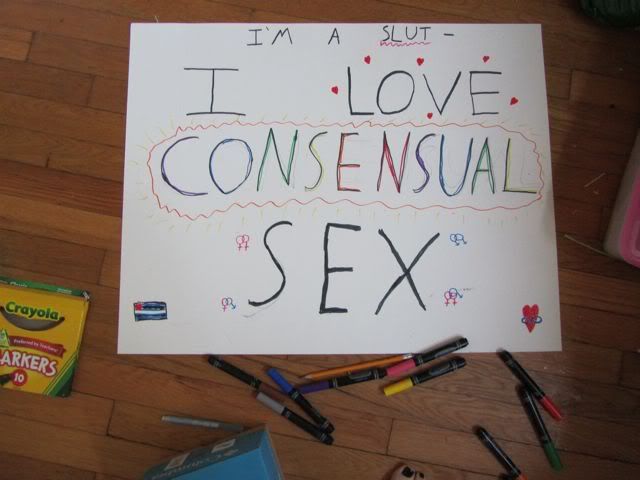
Mine: I'm a slut - I love consensual sex
Jesus ⟨3 Sluts
You got 99 problems and all of them are MISOGYNY
Love does not divide, it multiplies
I can have scalable, high-fidelity, multi-core love if I want to (this guy was awesome)
I hope the message isn't too diluted. A lot of people not involved seemed to be taking it as "HEY WE'RE SLUTS WAAARGH," rather than getting all the nuances of "Someone being a slut does not excuse shaming, harassment, or sexual assault." Was that a lot of nuances? Apparently it is.
That is, big letters now:
SOMEONE BEING A SLUT DOES NOT EXCUSE SHAMING, HARASSMENT, OR SEXUAL ASSAULT.
There was a "Pimp Walk." Five or six loud assholes. I don't think they were exactly anti-slut or pro-rape (maybe I give them too much credit), they were just there to make the rhetorical equivalent of fart noises. "You say women deserve safety no matter how they dress? Well, we say *FRRRTT* hahaha sluts hahaha *FRRRTTT* bro-five!" Something about that well-thought-out.
It was impressive, and wonderful, and strengthening to see just how many people turned out and how passionate they were. There's a lot of people on our side here and I think there's getting to be more. If all this got us one more, it was worth it.
On the walk and subway ride over, I hid my sign very carefully. Got catcalled twice anyway.
It's funny to think, the impact of the actual walk wasn't so much; we probably got seen by a few hundred people tops. The real impact, if there is one, comes when the photos get out in the news and on the Internet.
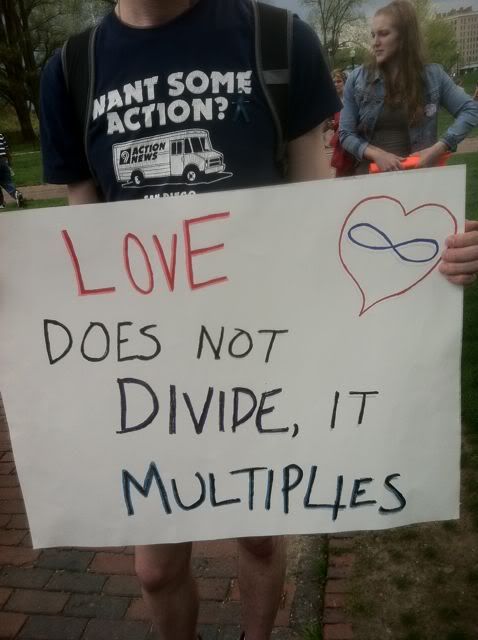
Here's a couple of the signs I saw there:
Mine: I'm a slut - I love consensual sex
Jesus ⟨3 Sluts

You got 99 problems and all of them are MISOGYNY
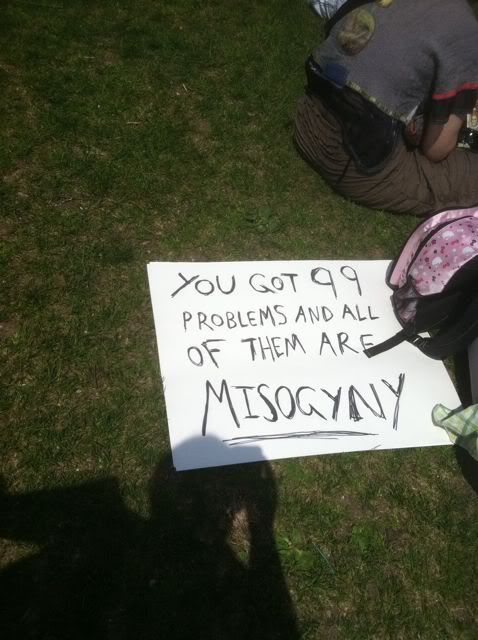
Love does not divide, it multiplies
I can have scalable, high-fidelity, multi-core love if I want to (this guy was awesome)

I hope the message isn't too diluted. A lot of people not involved seemed to be taking it as "HEY WE'RE SLUTS WAAARGH," rather than getting all the nuances of "Someone being a slut does not excuse shaming, harassment, or sexual assault." Was that a lot of nuances? Apparently it is.
That is, big letters now:
SOMEONE BEING A SLUT DOES NOT EXCUSE SHAMING, HARASSMENT, OR SEXUAL ASSAULT.
There was a "Pimp Walk." Five or six loud assholes. I don't think they were exactly anti-slut or pro-rape (maybe I give them too much credit), they were just there to make the rhetorical equivalent of fart noises. "You say women deserve safety no matter how they dress? Well, we say *FRRRTT* hahaha sluts hahaha *FRRRTTT* bro-five!" Something about that well-thought-out.
It was impressive, and wonderful, and strengthening to see just how many people turned out and how passionate they were. There's a lot of people on our side here and I think there's getting to be more. If all this got us one more, it was worth it.
On the walk and subway ride over, I hid my sign very carefully. Got catcalled twice anyway.
Friday, May 6, 2011
Slutwalk.
Tomorrow, at noon, a group of protestors will be walking around Boston Commons (starting from the bandstand near Emerson) to protest rape, rape culture, and slut-shaming. I'll be with them.
The event is called the Boston Slutwalk and it was inspired by a similar event in Toronto, which was in turn inspired by a police officer declaring that women could avoid rape by avoiding dressing like "sluts."
Of course, it's not about that officer, who's long since apologized and all that. It's about all the people who agree with him. All the people who think that rape is terrible and no one deserves it, but wearing that on the street at night is kinda risky, doncha think? And all the people who make those people even a little bit right.
It's about the hideous conflation, made by the "good guys" and "bad guys" alike, of people who like sex with people who invite rape. (Hint: the first group is most of the world and the second group is fuckin' nobody.)
Come dressed as a slut: which is to say, in a short skirt and tank top, or in jeans and a t-shirt, or in business casual, or in short-shorts and a muscle tee, or in a big comfy jacket and sweatpants...
I'll be there with a sign saying "I'm a slut: I love CONSENSUAL sex!" Come join me if you're in Boston and free tomorrow, it'll be fun, meaningful, and prove a really important goddamn point--there's nothing wrong with being a slut, and there shouldn't be anything dangerous about it either.
The event is called the Boston Slutwalk and it was inspired by a similar event in Toronto, which was in turn inspired by a police officer declaring that women could avoid rape by avoiding dressing like "sluts."
Of course, it's not about that officer, who's long since apologized and all that. It's about all the people who agree with him. All the people who think that rape is terrible and no one deserves it, but wearing that on the street at night is kinda risky, doncha think? And all the people who make those people even a little bit right.
It's about the hideous conflation, made by the "good guys" and "bad guys" alike, of people who like sex with people who invite rape. (Hint: the first group is most of the world and the second group is fuckin' nobody.)
Come dressed as a slut: which is to say, in a short skirt and tank top, or in jeans and a t-shirt, or in business casual, or in short-shorts and a muscle tee, or in a big comfy jacket and sweatpants...
I'll be there with a sign saying "I'm a slut: I love CONSENSUAL sex!" Come join me if you're in Boston and free tomorrow, it'll be fun, meaningful, and prove a really important goddamn point--there's nothing wrong with being a slut, and there shouldn't be anything dangerous about it either.
Tuesday, April 12, 2011
Multiplicity and the feeling of opening your mind.
A multiple system, or one of its members (apologies because I will fuck up terminology here) commented on my last post about how often they face the "well, you're different, there's yer problem" attitude themselves. And it made me realize, this was one of those things I'd pretty much been skating with the prevailing wisdom on--"oh come on, you're crazy or a liar." And this was the first time I thought to question that. Here's the process I went through:
What have I heard from other people about this?
In Abnormal Psychology, we covered "Dissociative Identity Disorder" very briefly. The professor told us that it was a very strange phenomenon occurring very rarely after extremely severe trauma, and that any cases we encountered clinically were likely being faked for attention. (Doing something "for attention" is the worst in psychology. Yes, it's often disruptive or annoying when someone is "LOOK AT ME LOOK AT ME" all the time, but some degree of attention is a legitimate need and a lot of people in psych treatment settings are freaking starved for anything more than "that's nice, now sit down and shut up.") And, of course, we should all be on guard for the personality that's an evil murderer, because there's always one of those.
Then again, Abnormal Psych also classified sexual sadism and masochism as terrible disorders in need of curing. Admittedly there's a little addendum about "if it is causing distress or impairment", but there wasn't any discussion whatsoever about how S/m without distress or impairment is a normal variation.
In addition, I'd run into some Internet Common Wisdom that pretending to be multiple is up there with pretending to be a dragon, as far as excessively imaginative people exaggerating their differences in order to be a Special Snowflake goes. (Being a Special Snowflake is the worst, because as in the psych hospital, it would be so much more convenient for me if everyone but me would accept their place as an out-of-focus background character in my story.)
What do people actually in this group say about themselves?
I followed the link in the comments and found--well, instead of filtering this through my own reading of it, I'll just link you directly to these FAQs about multiplicity: Ok Questions, Rude Questions.
Why do I feel differently about this?
If someone tells me that his name is Jeff and he's a man, but I can totally see he's got breasts, I don't tell him that he's "really" a woman, and if he disagrees he must have a disorder or just be some kind of attention-grubbing Special Fucking Snowflake. Or if someone tells me that his name is Jeff and he's a man and he's dating another man, I don't tell him that he's "really" attracted to women, and anything else is a mistake he made. Or, for that matter, if someone tells me that her name is Jess and she's a woman and she's working in a technical job and not having children, I sure as hell don't tell her what "real women" do with their lives.
In short, I don't prioritize my cognitive bias for having people live exactly the way they "look" over those people's rights to live their lives.
So why is this different? Why do I feel an urge to tell these people that they're "really" one person, because only one person can "really" exist in a brain? Honestly, I haven't got an answer beyond sheer familiarity. I'm used to only knowing one person per brain, and I feel like I've only got one in mine. But I'm far enough beyond infancy that "I'm not used to you, so you can't be real!" really shouldn't be a part of my worldview.
What's the worst that could happen?
The worst that could happen if I stick with the psych professor and Internet asshole's viewpoint, and go "ah hah, this person is either super crazy or just making shit up," is that I deny the existence of entire people. If it's upsetting for me to be told that some parts of my identity aren't real or healthy (fun fact: a woman who dates men can't possibly "really" be bi!), how much more would it suck to be told that I literally didn't exist? And while I'm thinking "crazy or liar," I can't treat multiple people with any kind of understanding or decency or even politeness, online or in the real world.
The worst that could happen if I accept people's own self-definitions of their minds and their lives, trusting that they know themselves better than some Internet stranger who took a psychology class? Well, I could be wrong. I could be getting suckered. And then what? I'd look a little silly. I'd be using the "wrong" pronouns and names, oh no. No one would be really harmed or discriminated against. All that's really on the line is my ego.
It's not all about a cold "well, what's the harm?" balancing, of course. Fundamentally, I do believe that people know themselves, at least better than any pompous outsider proposing to tell them who they really are inside. But it helps to keep in mind that believing someone about their identity, and being wrong, is not nearly as bad as the reverse.
So that's my journey, in one particular instance, from prejudice to at least trying to accept a class of people different from myself. I don't expect a cookie, but I do hope to provide a template. Mostly for the next time someone's identity makes me go "aw c'mon, you're not really that."
What have I heard from other people about this?
In Abnormal Psychology, we covered "Dissociative Identity Disorder" very briefly. The professor told us that it was a very strange phenomenon occurring very rarely after extremely severe trauma, and that any cases we encountered clinically were likely being faked for attention. (Doing something "for attention" is the worst in psychology. Yes, it's often disruptive or annoying when someone is "LOOK AT ME LOOK AT ME" all the time, but some degree of attention is a legitimate need and a lot of people in psych treatment settings are freaking starved for anything more than "that's nice, now sit down and shut up.") And, of course, we should all be on guard for the personality that's an evil murderer, because there's always one of those.
Then again, Abnormal Psych also classified sexual sadism and masochism as terrible disorders in need of curing. Admittedly there's a little addendum about "if it is causing distress or impairment", but there wasn't any discussion whatsoever about how S/m without distress or impairment is a normal variation.
In addition, I'd run into some Internet Common Wisdom that pretending to be multiple is up there with pretending to be a dragon, as far as excessively imaginative people exaggerating their differences in order to be a Special Snowflake goes. (Being a Special Snowflake is the worst, because as in the psych hospital, it would be so much more convenient for me if everyone but me would accept their place as an out-of-focus background character in my story.)
What do people actually in this group say about themselves?
I followed the link in the comments and found--well, instead of filtering this through my own reading of it, I'll just link you directly to these FAQs about multiplicity: Ok Questions, Rude Questions.
Why do I feel differently about this?
If someone tells me that his name is Jeff and he's a man, but I can totally see he's got breasts, I don't tell him that he's "really" a woman, and if he disagrees he must have a disorder or just be some kind of attention-grubbing Special Fucking Snowflake. Or if someone tells me that his name is Jeff and he's a man and he's dating another man, I don't tell him that he's "really" attracted to women, and anything else is a mistake he made. Or, for that matter, if someone tells me that her name is Jess and she's a woman and she's working in a technical job and not having children, I sure as hell don't tell her what "real women" do with their lives.
In short, I don't prioritize my cognitive bias for having people live exactly the way they "look" over those people's rights to live their lives.
So why is this different? Why do I feel an urge to tell these people that they're "really" one person, because only one person can "really" exist in a brain? Honestly, I haven't got an answer beyond sheer familiarity. I'm used to only knowing one person per brain, and I feel like I've only got one in mine. But I'm far enough beyond infancy that "I'm not used to you, so you can't be real!" really shouldn't be a part of my worldview.
What's the worst that could happen?
The worst that could happen if I stick with the psych professor and Internet asshole's viewpoint, and go "ah hah, this person is either super crazy or just making shit up," is that I deny the existence of entire people. If it's upsetting for me to be told that some parts of my identity aren't real or healthy (fun fact: a woman who dates men can't possibly "really" be bi!), how much more would it suck to be told that I literally didn't exist? And while I'm thinking "crazy or liar," I can't treat multiple people with any kind of understanding or decency or even politeness, online or in the real world.
The worst that could happen if I accept people's own self-definitions of their minds and their lives, trusting that they know themselves better than some Internet stranger who took a psychology class? Well, I could be wrong. I could be getting suckered. And then what? I'd look a little silly. I'd be using the "wrong" pronouns and names, oh no. No one would be really harmed or discriminated against. All that's really on the line is my ego.
It's not all about a cold "well, what's the harm?" balancing, of course. Fundamentally, I do believe that people know themselves, at least better than any pompous outsider proposing to tell them who they really are inside. But it helps to keep in mind that believing someone about their identity, and being wrong, is not nearly as bad as the reverse.
So that's my journey, in one particular instance, from prejudice to at least trying to accept a class of people different from myself. I don't expect a cookie, but I do hope to provide a template. Mostly for the next time someone's identity makes me go "aw c'mon, you're not really that."
Monday, January 3, 2011
The Money Is Not The Problem Economic Theory.
I'd apologize for going off topic, but people never seem to mind--in fact, seems like I get more "ugh, sex again?" mail then I get "hey, stick to the sex!" So if you want your underinformed economic opinions from your kinky sex blogs, read on. (I did take a semester of Econ, but only because I was already buddies with the professor and babysat her kids so I figured easy A... but in the end the "oh god, I can't embarrass myself by turning in junk to my friend!" shame made me work harder. I did get an A though.)
My personal macroeconomic theory is that Money Is Not The Problem. Money is a symbol. A symbol that can mean a lot microeconomically--how much of it you have, or how much your business has, sure feels like it matters--but on the scope of a nation or the world, money isn't the cause of most problems. Goods and services are.
For example, healthcare. The reason healthcare sucks in America is because we don't have enough doctors, nurses, hospital beds, or medications. In the hospital where I work, we often have people stay overnight in extra beds at the back of the ER when they should be admitted, because there isn't a single empty bed upstairs. We also suffer from frequent shortages of medications as basic as morphine. These aren't money problems, these are stuff problems. Declaring morphine free wouldn't make poppies grow any faster.
And I think this is the problem with attempting to address income inequality by redistributing money. If the things to be bought with that money don't change, then socioeconomic classes don't change. If everyone can afford a mansion, but your city has one neighborhood of mansions and ten of run-down high-density apartment blocks... run-down apartments get a whole lot more expensive. (In theory, who lives in the few available mansions could change, but history says good luck with that.)
The problem a society has to solve if it wants everyone to be wealthy, or at least everyone to be doing okay, is how to get everyone good stuff. Money is a small piece of that puzzle. Technology is a much bigger one, as are education and entrepreneurship.
There aren't any doctors sitting around idly in empty offices wishing someone could afford them. You want better healthcare in America? Train more doctors and nurses. Open more hospitals. Make more drugs. What they cost will be a whole lot easier to sort out--in fact, may work itself out--once there's actually enough of them. When you're trying to feed fifty people with one pie, don't waste your time thinking up wacky schemes to cut it just so; go bake a bigger pie.
And this is why I don't buy organic.
My personal macroeconomic theory is that Money Is Not The Problem. Money is a symbol. A symbol that can mean a lot microeconomically--how much of it you have, or how much your business has, sure feels like it matters--but on the scope of a nation or the world, money isn't the cause of most problems. Goods and services are.
For example, healthcare. The reason healthcare sucks in America is because we don't have enough doctors, nurses, hospital beds, or medications. In the hospital where I work, we often have people stay overnight in extra beds at the back of the ER when they should be admitted, because there isn't a single empty bed upstairs. We also suffer from frequent shortages of medications as basic as morphine. These aren't money problems, these are stuff problems. Declaring morphine free wouldn't make poppies grow any faster.
And I think this is the problem with attempting to address income inequality by redistributing money. If the things to be bought with that money don't change, then socioeconomic classes don't change. If everyone can afford a mansion, but your city has one neighborhood of mansions and ten of run-down high-density apartment blocks... run-down apartments get a whole lot more expensive. (In theory, who lives in the few available mansions could change, but history says good luck with that.)
The problem a society has to solve if it wants everyone to be wealthy, or at least everyone to be doing okay, is how to get everyone good stuff. Money is a small piece of that puzzle. Technology is a much bigger one, as are education and entrepreneurship.
There aren't any doctors sitting around idly in empty offices wishing someone could afford them. You want better healthcare in America? Train more doctors and nurses. Open more hospitals. Make more drugs. What they cost will be a whole lot easier to sort out--in fact, may work itself out--once there's actually enough of them. When you're trying to feed fifty people with one pie, don't waste your time thinking up wacky schemes to cut it just so; go bake a bigger pie.
And this is why I don't buy organic.
Thursday, December 23, 2010
You all get screwed equally!
Insurance company rep: "We recognize gay marriage in this state, so male or female, doesn't matter, your spouse is covered. Because of this, we don't cover unmarried domestic partners of any kind. Male or female."
Even though they end up insuring far fewer people in the end, I still can't help but feel a little heartwarmed.
(The question of polyamorous marriage kinda runs into a hitch here. Asking an insurance company to cover my husband or wife shouldn't matter to them [actually, women have higher healthcare costs, but as long as the overall population is still 50-50 it doesn't matter who's paired with whom], but asking them to cover my husband and wife would be a different thing. Maybe they'd just have to say "okay, but we're gonna charge you for it" and come up with a new "Family Plus" rate category.)
Even though they end up insuring far fewer people in the end, I still can't help but feel a little heartwarmed.
(The question of polyamorous marriage kinda runs into a hitch here. Asking an insurance company to cover my husband or wife shouldn't matter to them [actually, women have higher healthcare costs, but as long as the overall population is still 50-50 it doesn't matter who's paired with whom], but asking them to cover my husband and wife would be a different thing. Maybe they'd just have to say "okay, but we're gonna charge you for it" and come up with a new "Family Plus" rate category.)
Thursday, December 9, 2010
Proverbs 22:6.
Something that seems to get lost in a lot of discussions on sex ed: sex ed is not just for children and teenagers. It's for future adults. It seems like there's a lot of talk about what a fourteen-year-old needs to know, and not about what a person will eventually need to know. A lot of statistics and speculation about teenage sexual activities and STDs and pregnancy, and not enough about these things in the general population.
High school isn't about learning to be fourteen years old. Most kids show up already knowing how to listen to terrible music and sleep until 3pm on weekends. Why teach a fourteen-year-old biology or trigonometry when the only job a fourteen-year-old is likely to have is burger-flipping? Because you're not teaching the fourteen-year-old; you're teaching the future thirty-year-old doctor or architect.
(Digression: I really wish schools did more to teach for adulthood in general. I'd gladly have given up a semester of Western Civ to have had a class on "how to find a job and an apartment" or "how to treat minor illnesses and when to see a doctor." There's a place for high-minded well-rounded education and I don't want to be one of those dicks who asks "when am I ever gonna need to know about stupid old ancient Greece?", but I'd gladly sacrifice a little bit of Greece to get in a couple hours of lecture and discussion on "how to tell if something is a scam.")
And sex, as it so often turns out, isn't some sort of special case. When you teach a fourteen-year-old how to put on a condom or what consent means, you're teaching a twenty-year-old. And a thirty-year-old. They may not look it right now, but when you teach sex ed to a bunch of immature teenagers, you're teaching college students, married people, parents, police officers, journalists, legislators, and sex ed teachers. You're telling them things they'll remember, and maybe still rely on, when they're a bunch of fifty-year-olds.
You wanna stick "all you need to know right now is abstinence" on them?
P.S.: "Train up a child in the way he should go: and when he is old, he will not depart from it." I didn't want to make the actual quote the title because I didn't like the "he" language but felt it would be artificial to remove it, but now you don't have to look it up.
High school isn't about learning to be fourteen years old. Most kids show up already knowing how to listen to terrible music and sleep until 3pm on weekends. Why teach a fourteen-year-old biology or trigonometry when the only job a fourteen-year-old is likely to have is burger-flipping? Because you're not teaching the fourteen-year-old; you're teaching the future thirty-year-old doctor or architect.
(Digression: I really wish schools did more to teach for adulthood in general. I'd gladly have given up a semester of Western Civ to have had a class on "how to find a job and an apartment" or "how to treat minor illnesses and when to see a doctor." There's a place for high-minded well-rounded education and I don't want to be one of those dicks who asks "when am I ever gonna need to know about stupid old ancient Greece?", but I'd gladly sacrifice a little bit of Greece to get in a couple hours of lecture and discussion on "how to tell if something is a scam.")
And sex, as it so often turns out, isn't some sort of special case. When you teach a fourteen-year-old how to put on a condom or what consent means, you're teaching a twenty-year-old. And a thirty-year-old. They may not look it right now, but when you teach sex ed to a bunch of immature teenagers, you're teaching college students, married people, parents, police officers, journalists, legislators, and sex ed teachers. You're telling them things they'll remember, and maybe still rely on, when they're a bunch of fifty-year-olds.
You wanna stick "all you need to know right now is abstinence" on them?
P.S.: "Train up a child in the way he should go: and when he is old, he will not depart from it." I didn't want to make the actual quote the title because I didn't like the "he" language but felt it would be artificial to remove it, but now you don't have to look it up.
Subscribe to:
Posts (Atom)